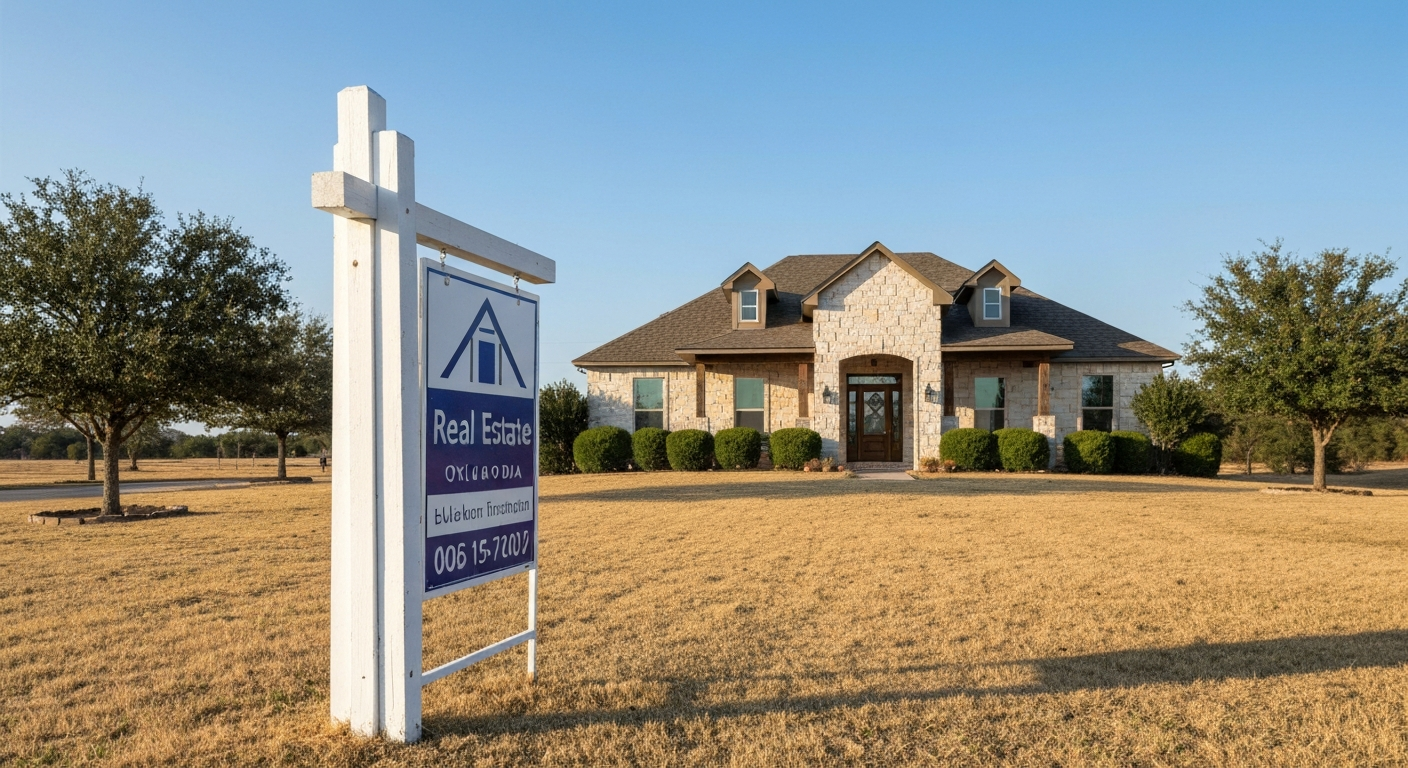
How to Start a Real Estate Business in Oklahoma
How to Start a Real Estate Business in Oklahoma
Oklahoma’s real estate market runs on the same fuel as every other state: licensed agents and brokers. But the path to that license — and what it costs to build a business around it — looks different here than it does in Texas, California, or anywhere else.
Here’s the short version: 90 hours of pre-licensing education, a two-part state exam at $75 per section, and a license fee between $100 and $215 to get started as a salesperson. If you’re aiming for broker status and your own shop, add more education, more experience, and a $295 license fee. No franchise tax in Oklahoma (repealed in 2024). Office space is cheap compared to coastal markets. The barriers are real but manageable.
Start with the Oklahoma Real Estate Commission. Everything flows through them — approved education providers, exam requirements, license applications. Their site is oklahoma.gov/orec.
Getting Your Salesperson License
This is the entry point. Before you can represent buyers or sellers, you need a salesperson license from OREC. The process has five distinct steps, and the order matters.
Step 1: Complete 90 Hours of Pre-Licensing Education
Oklahoma requires 90 hours of pre-licensing coursework from an OREC-approved provider. That’s more than Georgia (75 hours) but less than California (135 hours) — it puts Oklahoma roughly in the middle of the national range.
The 90 hours cover real estate principles, Oklahoma license law, contracts, finance, and fair housing. You can take the courses in-person or online depending on the provider. Online options have made this more flexible — you can work through the material around a day job if you’re making the transition gradually.
At the end of the coursework, you have to pass a final course exam with a score of 80% or higher. That’s not the state exam — that comes next. The course exam just confirms you actually absorbed the material before you sit for the official test.
OREC maintains a list of approved education providers on their website. Costs vary by provider, but budget $300–$600 for the full 90-hour course.
Step 2: Pass the State Exam
Once you’ve completed your pre-licensing education and passed the course final, you’re eligible to sit for the Oklahoma Real Estate Salesperson Exam. The exam is administered in two sections, and each section costs $75 — so $150 total if you pass both on the first attempt.
The two sections are the national portion (general real estate principles applicable across the country) and the state portion (Oklahoma-specific law, OREC rules, and practice). You need to pass both. If you fail one section, you retake just that section at $75 per attempt.
Schedule your exam through the OREC-approved testing vendor listed on oklahoma.gov/orec. Bring your course completion certificate and valid ID.
Step 3: Background Check
Before your license gets issued, you need a background check through IdentoGO. The fee is $60. This is standard across most states — OREC needs to verify you don’t have disqualifying criminal history before putting a licensed agent in front of clients.
Don’t wait on this. Background checks can take time, and there’s no reason to have your paperwork ready but your license delayed because you submitted the background check late.
Step 4: Get Sponsored by a Broker
You cannot practice real estate in Oklahoma as an independent agent. Your license must be held under a sponsoring broker — a licensed Oklahoma broker who supervises your work. This is true in virtually every state, and it makes practical sense: new agents need oversight, mentorship, and a transaction infrastructure they haven’t built yet.
Pick your sponsoring broker before you apply for your license. Most applicants have a broker lined up before they even take the exam. Some brokers recruit actively at pre-licensing schools. Think about commission splits, training quality, brand recognition, and office culture. The split matters less than the mentorship in your first year.
Step 5: Apply for Your License
With your education completed, exam passed, background check submitted, and broker identified, you’re ready to apply to OREC for your license.
There are two salesperson license tiers:
Provisional Sales Associate — $100. This is the starting point. A provisional license is issued to new licensees who haven’t yet completed the required post-licensing education. You can practice under this license, but you have obligations to fulfill (more on that below).
Sales Associate — $215. Once you’ve completed the post-licensing requirement, your license upgrades to full Sales Associate status.
Most people start at the provisional level and move up after completing the post-licensing course.
The 45-Hour Post-Licensing Course (Year 1 Obligation)
This one catches people off guard. Within your first year of holding a provisional license, you must complete a 45-hour post-licensing course approved by OREC.
This isn’t continuing education — it’s a required curriculum for new licensees, covering topics that go deeper on contracts, Oklahoma law, and professional practice. Think of it as the second half of your foundational training. Fail to complete it within Year 1 and your license goes inactive.
Budget time and money for this from the start. It’s not optional, it’s not deferrable, and it costs additional money on top of your pre-licensing coursework. Providers vary in price, but expect $200–$400 for the 45-hour post-licensing course.
Getting Your Broker License
A salesperson license lets you work under a broker. A broker license lets you run your own shop, hire agents, and operate independently. That’s a different level of responsibility — and a different set of requirements.
Education and Experience
OREC requires additional education beyond the salesperson pre-licensing coursework to qualify for a broker license. You also need documented experience — you have to have worked as a licensed salesperson for a period of time before you’re eligible.
The exact hour requirements and experience minimums are detailed on the OREC website. Plan on it being a multi-year path from first license to broker eligibility. This isn’t a fast track — it’s designed to ensure brokers have genuine field experience before they supervise others.
Broker License Fee: $295
Once you’ve met the education and experience requirements and passed the broker exam, the license issuance fee is $295. That’s the state fee to OREC — your education and exam costs are separate.
Renewal: Every 3 Years, 21 Hours CE
Oklahoma broker licenses renew every three years. Renewal requires 21 hours of continuing education (CE) from OREC-approved providers. The CE covers required core topics plus electives. Track your hours — don’t let your license lapse because you forgot a deadline.
Salesperson licenses follow the same renewal cycle. Check the OREC website for the exact renewal fees and CE provider list.
What Everything Actually Costs
Let’s put real numbers on this. Vague ranges are useless when you’re planning a budget, so here’s a breakdown by scenario.
Scenario 1: Starting as a Salesperson
| Item | Cost |
|---|---|
| Pre-licensing education (90 hours) | $300–$600 |
| State exam ($75 × 2 sections) | $150 |
| License fee (Provisional Sales Associate) | $100 |
| Background check (IdentoGO) | $60 |
| Total to get licensed | $610–$910 |
Add $215 if you upgrade to Sales Associate after completing your post-licensing course (the difference between the provisional and full license fee). Add $200–$400 for the 45-hour post-licensing course itself.
Realistic all-in cost to get through Year 1 as a salesperson: $535–$950 for the core startup, with the post-licensing course adding another $200–$400 on top.
Scenario 2: Business Entity (LLC)
Most agents eventually operate through an LLC for liability protection and tax flexibility. In Oklahoma, an LLC costs $100 to file with the Oklahoma Secretary of State at sos.ok.gov, plus a $25 annual certificate. No franchise tax — Oklahoma repealed it in 2024, which eliminates an ongoing cost that would run you hundreds of dollars per year in states like California.
Scenario 3: Starting a Brokerage
Opening your own brokerage is a different financial proposition than getting licensed as an agent.
Total brokerage startup with office: $15,000–$60,000.
That range reflects the difference between a lean virtual brokerage and a traditional office setup. The major cost variables:
Office space. Oklahoma City and Tulsa are significantly cheaper than coastal metros. A small professional office in OKC suburbs might run $1,000–$2,500/month. That’s a fraction of what you’d pay in Denver or Austin. Some new brokers start home-based or virtual and add office space once volume justifies it.
Errors & omissions insurance. Not optional. E&O coverage protects your brokerage if a transaction goes sideways and a client sues. Annual premiums for a small brokerage typically run $2,000–$5,000 depending on transaction volume and coverage limits.
Technology and MLS access. You need MLS membership, a CRM, transaction management software, and a website. Budget $2,000–$5,000 for setup, plus ongoing monthly fees.
Agent recruitment and onboarding. If you’re building a team, expect to invest in training materials, signage, and marketing before your agents are fully productive.
Working capital. Brokerage revenue is commission-based and lumpy. You need runway — at minimum three to six months of operating expenses in reserve before you open doors.
Oklahoma’s low overhead makes brokerage ownership genuinely accessible compared to high-cost states. No franchise tax, affordable real estate, and a market that rewards local market knowledge over brand recognition.
Practical Notes Before You Start
OREC is your primary resource. oklahoma.gov/orec has the approved education provider list, exam scheduling information, license applications, and the current fee schedule. Check it directly — fees and requirements do get updated.
Choose your pre-licensing provider carefully. Not all 90-hour courses are equal. Some providers have significantly better pass rates on the state exam. Ask about first-attempt pass rates before you enroll. A $100 savings on tuition isn’t worth it if you’re paying $75 twice to retake a section.
The broker question is worth thinking about early. Even as a new salesperson, you should be evaluating brokerages with an eye toward where you want to be in five years. Some brokers offer genuine mentorship and training infrastructure. Others offer a desk and a split. The difference matters enormously for how quickly you build skills and a client base.
Eastern Oklahoma and tribal jurisdiction. The McGirt v. Oklahoma decision created ongoing jurisdictional complexity in eastern Oklahoma, particularly for transactions involving land within tribal boundaries. If you’re planning to practice in that region, understand that some real estate matters intersect with tribal law and federal jurisdiction. It’s a layer of complexity that doesn’t exist in the western part of the state. An attorney familiar with tribal jurisdiction is worth knowing.
Your EIN is free. If you form an LLC or plan to hire anyone, you need an Employer Identification Number. Get it at irs.gov/ein — takes about ten minutes, no fee.
The Path Forward
Getting licensed in Oklahoma is straightforward if you treat it as a project with defined steps: 90 hours of education, an 80% on the course final, two exam sections at $75 each, a $60 background check, a sponsoring broker, and a license fee. Most people who start the process finish it. The ones who don’t usually stall on picking a broker or delay the background check until it’s a problem.
If brokerage ownership is the goal, treat the salesperson years as your apprenticeship. Learn the market. Build a client database. Understand the transaction process in detail. The broker exam and the business startup costs are manageable — the harder part is building a book of business that can sustain a brokerage overhead.
Start at oklahoma.gov/orec, find an approved pre-licensing provider, and schedule your education. Everything else follows from there.