How to Start a Nail Salon Business in Oklahoma
How to Start a Nail Salon in Oklahoma
Oklahoma’s nail salon market is genuinely accessible. No franchise tax (repealed January 1, 2024), affordable commercial leases outside of major metros, and a straightforward licensing path through one agency — the Oklahoma State Board of Cosmetology and Barbering (OSBCB). If you’ve got the training, the space, and a realistic startup budget, you can be open in a few months.
Here’s exactly what you need to do.
Form Your Business First
Before you apply for a single license, get your business structure in place. Most nail salon owners go with an LLC. It separates your personal finances from the business and protects your assets if something goes sideways — a slip-and-fall, a chemical reaction claim, whatever.
Oklahoma LLC formation costs $100, filed online at sos.ok.gov. After that, you pay $25 per year on your formation anniversary to keep it active. That’s genuinely cheap. California charges $800 every year just in franchise tax. Oklahoma charges nothing — and as of 2024, that’s permanent.
Once your LLC is active, get your EIN from the IRS at irs.gov/ein. Free, takes ten minutes. You’ll need it to open a business bank account and to register with the Oklahoma Tax Commission.
If you’re collecting sales tax on products — retail polish, nail kits, that kind of thing — register for a Sales Tax Permit through OkTAP at oktap.tax.ok.gov. The permit runs $20 plus a handling fee. Oklahoma’s base sales tax rate is 4.5%, but local rates push the total to 7-11% depending on your city.
OSBCB Establishment License
Every nail salon operating in Oklahoma needs an establishment license from the OSBCB. This is non-negotiable. You cannot legally operate a nail salon without it, and you cannot get it after you open — the license comes first.
The fee: $120 for your initial establishment license, $90 to renew.
Apply through the OSBCB at oklahoma.gov/cosmo. The application requires your business information, proof of your physical location, and documentation showing your space meets board requirements for sanitation and safety.
Once you’re licensed, expect at least two inspections per year. These aren’t optional visits you can reschedule indefinitely — the OSBCB sends inspectors on their schedule, and your salon needs to pass. Inspections cover sanitation protocols, equipment standards, licensing verification (every technician on your floor must hold a valid OSBCB license), and ventilation. More on that last one in a moment.
One thing people miss: the establishment license doesn’t cover your technicians. Each nail tech working in your salon — including you, if you’re behind the table — needs their own individual OSBCB license. An inspector who finds an unlicensed tech working in your salon won’t just have a conversation with you. That’s a violation with real consequences.
The OSBCB can be reached directly at [email protected] if you have questions during the application process.
Nail Technician License Requirements
Nail technicians in Oklahoma are licensed through the OSBCB. If you’re hiring, your applicants need to come in already licensed or be actively enrolled in an approved program — you can’t train them on the job.
Step 1: Complete an OSBCB-approved nail technology program.
The program must be at a school approved by the board. These programs cover nail anatomy, product chemistry, sanitation, application techniques, and safety procedures. Check the OSBCB website for a list of approved schools.
Step 2: Pass written and practical exams.
After completing the program, candidates must pass both a written exam and a practical exam before they can receive a license. The written portion tests knowledge of sanitation, safety, and nail technology theory. The practical exam is hands-on — examiners watch technique.
Step 3: Apply for the license.
Once exams are passed, the technician applies to the OSBCB for their individual license. Without that license in hand, they cannot legally perform nail services for compensation. That includes manicures, pedicures, acrylics, gels — anything.
If you’re planning to work in your own salon, you need to go through this same process. There’s no owner exemption. And if you hire someone who tells you they “used to be licensed in another state,” check with the OSBCB about reciprocity or endorsement options — don’t just take their word for it.
Ventilation and Safety Requirements
This section gets skimmed. Don’t skim it.
Nail salons have a chemical exposure problem that hair salons and barbershops largely don’t. Acrylic systems use ethyl methacrylate (EMA) and other compounds that off-gas continuously during application. Gel products use photoinitiators and other chemicals. UV/LED lamps, dust from filing, and solvent-based removers add to the mix. Technicians working eight-hour shifts in poorly ventilated spaces face real health risks — and so do clients.
The OSBCB knows this. Ventilation compliance is a specific focus area during inspections, not a box they glance at.
What “proper ventilation” means in practice:
Your salon needs adequate air exchange to remove chemical fumes and particulate matter. A standard HVAC system designed for retail space almost never meets this standard on its own. Most nail salons that pass inspection use a combination of:
- Source capture ventilation at each nail station — a small duct or exhaust system built into or positioned at the work surface that pulls fumes away before they reach the technician’s breathing zone
- General exhaust ventilation to maintain fresh air throughout the space
- Pedicure areas with proper drainage and sanitation systems
When you’re negotiating your lease and planning your build-out, ventilation is not the place to cut costs. An inspector who finds inadequate ventilation can delay or deny your establishment license. Budget $2,000-$5,000 for a proper system, depending on your square footage and how many stations you’re building out. Get a contractor who has done nail salon work before — they’ll know the requirements without needing hand-holding.
Sanitation protocols are the other inspection focus. The OSBCB expects:
- Proper disinfection of all non-porous tools between every client
- Single-use files, buffers, and other items that can’t be adequately sanitized
- Labeled disinfectant solutions maintained at correct concentration
- Documented sanitation logs (some inspectors ask for these)
- Clean storage for implements, separate from dirty/used ones
- Pedicure basin sanitation procedures that meet board standards — pedicure bowls must be flushed, cleaned, and disinfected between every client with a minimum soak time
This isn’t optional — it’s the core of what OSBCB inspections look at. Build your sanitation protocols into your daily opening and closing routines from day one, not after your first failed inspection.
Other Oklahoma Requirements
Workers’ compensation insurance: Oklahoma requires it for all employers, no minimum employee threshold. The moment you hire your first technician, you need coverage. CompSource Mutual is the state option, but private carriers are also available. Don’t skip this — it’s not a “probably won’t need it” situation in a salon where people work with sharp tools and chemicals daily.
Local business licenses: Oklahoma has no statewide general business license. But your city or county may require one. Oklahoma City, Tulsa, and other municipalities have their own requirements. Check with your local city clerk’s office before you open.
Signage and zoning: Make sure your space is zoned for personal care services before you sign a lease. Your landlord may say yes, but zoning is a separate question.
Startup Costs at a Glance
Oklahoma’s combination of low state fees and affordable commercial real estate outside of major metros makes nail salon ownership genuinely more accessible here than in most states. Here’s a realistic picture:
| Item | Estimated Cost |
|---|---|
| LLC formation | $100 (+ $25/year) |
| OSBCB establishment license | $120 |
| Nail stations (per station, $500-$1,500 × 4) | $2,000–$6,000 |
| Pedicure chairs | $4,000–$15,000 |
| Ventilation system | $2,000–$5,000 |
| Build-out (flooring, plumbing, lighting) | $10,000–$25,000 |
| Business insurance | $1,000–$3,000/year |
| Total lean startup | $20,000–$45,000 |
A few notes on these numbers:
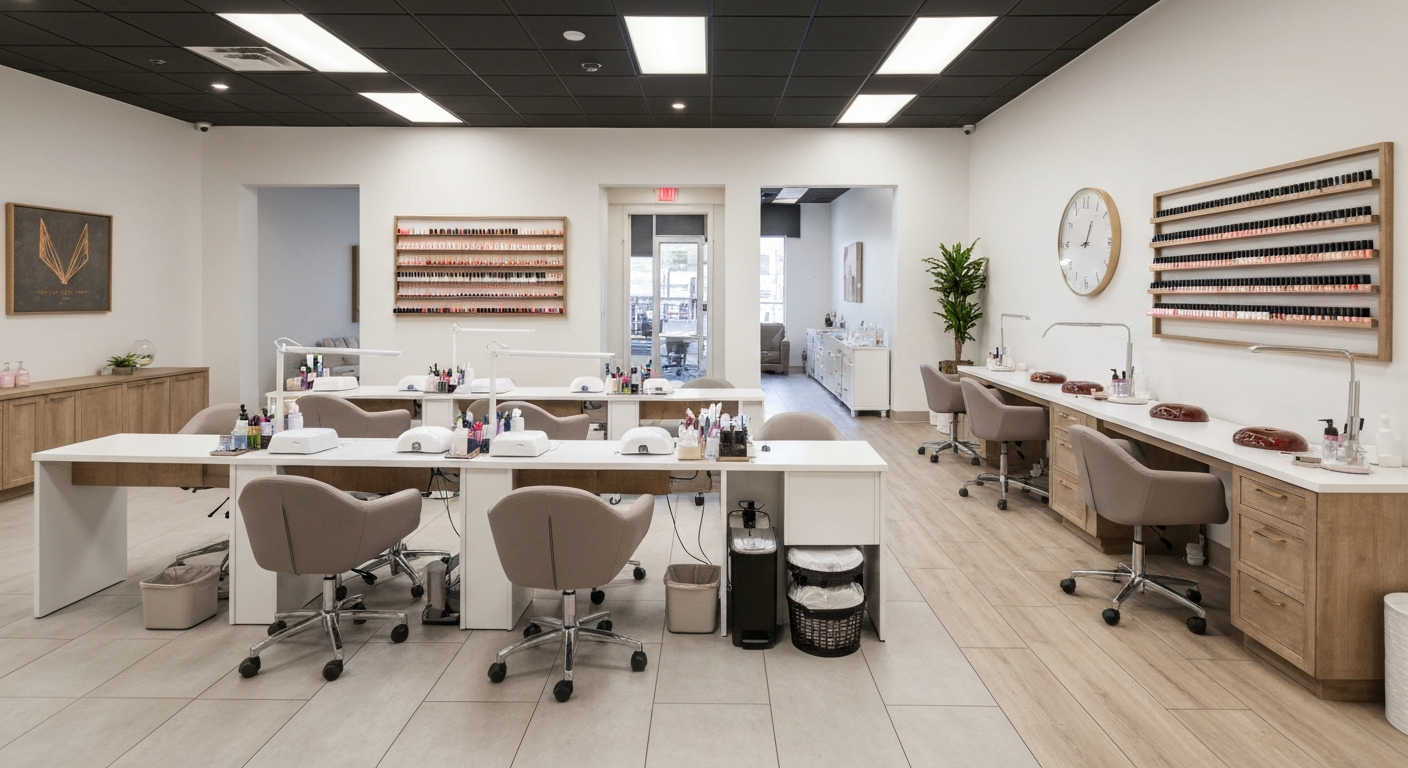
Nail stations vary dramatically. A basic station is a table with a lamp and a ventilation arm — you can furnish a starter salon frugally. The high end is custom-built cabinetry with integrated exhaust.
Pedicure chairs are where costs surprise people. A basic pipeless pedicure chair starts around $1,500-$2,000. The premium massage chairs with multiple settings run $4,000-$7,000 each. A five-chair pedicure section with mid-range equipment gets expensive fast. Used equipment is a legitimate option — just verify it meets OSBCB sanitation standards before buying, especially for pedicure basins.
Ventilation is non-negotiable, as covered above. Budget on the higher end if you’re building out more than four stations.
Build-out depends almost entirely on what condition the space is in when you lease it. A former salon space with plumbing already in place is a very different project than a raw retail shell. In Oklahoma City and Tulsa, tenant improvement allowances from landlords are sometimes negotiable — ask.
Insurance should include general liability at minimum. Workers’ comp is required if you have employees. Professional liability (errors and omissions) is worth considering given the chemical services involved.
The $20,000-$45,000 range assumes you’re leasing a modest space, buying mix of new and used equipment, and not going overboard on decor. Plenty of successful Oklahoma nail salons launched in that range.
Your Next Steps
The licensing path is clear. Here’s the order that makes sense:
- Form your LLC at sos.ok.gov — $100
- Get your EIN at irs.gov/ein — free
- Secure your location — verify zoning before signing anything
- Apply for your OSBCB establishment license at oklahoma.gov/cosmo — $120
- Confirm all technicians are OSBCB-licensed before your first client
- Register with the Oklahoma Tax Commission if selling retail products at oktap.tax.ok.gov
- Get workers’ comp coverage before your first employee starts
The OSBCB is your main regulatory contact. Their email is [email protected]. If you have questions about establishment license requirements, approved nail technology programs, or what inspectors specifically look for, contact them directly — they’re the authoritative source, not Reddit.
Oklahoma’s cost structure genuinely works in your favor here. Low fees, no franchise tax, and commercial lease rates that are a fraction of what you’d pay in Denver or Austin. The regulatory requirements are real but manageable if you approach them methodically. Get the paperwork right before you open, build your ventilation properly, and make sure every technician working in your salon is licensed. Do those three things and you’re starting from a solid foundation.