How to Start a Lawn Care Business in Oklahoma
How to Start a Lawn Care Business in Oklahoma
Oklahoma’s lawn care market is genuinely accessible. Unlike some states that license practically everything, Oklahoma doesn’t require a state license to mow grass, edge sidewalks, or haul clippings. If you want to start a mow-and-go operation, a city business license and an LLC are basically all the paperwork standing between you and your first customer.
But the moment you add pesticide or fertilizer applications — weed control, pre-emergent, insect treatment — the rules change completely. A separate license from the Oklahoma Department of Agriculture, Food and Forestry (ODAFF) is legally required before you spray anything commercially. That requirement catches a lot of new operators off guard, usually after they’ve already started advertising.
Here’s exactly what you need to know before you put a truck on the road.
Licensing Requirements
Basic Mowing and Maintenance
For pure lawn maintenance — mowing, edging, trimming, blowing — Oklahoma has no state license requirement. None. You don’t register with any state agency. You don’t pass any exam. You just need a city business license from your local municipality.
Every city handles this differently. Oklahoma City, Tulsa, Broken Arrow, Norman — each has its own application process and fee, usually somewhere between $25 and $100. Contact your city clerk’s office or check your city’s website to find the specific form. Don’t skip it. Operating without a required local license can result in fines, and it’s also the kind of thing that comes up when you’re trying to land commercial contracts.
That’s the short version: mow-only operation, no state involvement required.
Pesticide Application: The ODAFF License
Add any pesticide service to your menu and you’re in different territory. Oklahoma law requires a Commercial Pesticide Applicator license from the Oklahoma Department of Agriculture, Food and Forestry before you commercially apply any pesticide — including herbicides for weed control and insecticides for pest treatment. This applies even if you’re applying EPA-registered products that homeowners can buy at Home Depot. The commercial application triggers the requirement.
The process has two distinct steps, and this is where a lot of people get tripped up.
Step 1: Get certified. You pass the ODAFF exams — a core exam that covers general pesticide safety and handling, plus at least one category exam specific to your type of work. For lawn care, the relevant category is Ornamental and Turf (Category 3A). If you’re also doing lawn pest control, you may need additional categories.
The exams are offered through ODAFF. Study materials are available on the ODAFF website. Don’t underestimate the core exam — it covers federal pesticide law, label reading, environmental hazards, and safety protocols. Most people who fail do so because they skimmed the study guide.
Step 2: Get licensed. Here’s the detail that catches people: passing the exams earns you a certification card. That is NOT a license. You must then apply separately for the Commercial Pesticide Applicator license using that certification. The license is what legally authorizes you to apply pesticides commercially. Operating on just a certification card — without the actual license — is a violation.
The license fee is $100 per category, with a cap of $500 total per year. So if you only need Ornamental and Turf, you’re paying $100. If you pick up multiple categories, the cost tops out at $500 annually. Licenses must be renewed each year.
Liability insurance is also required for all commercial pesticide applicators in Oklahoma. This isn’t optional, and ODAFF requires proof of coverage. The specific minimums vary, so confirm current requirements directly with ODAFF when you apply — but plan for it as a real line item in your budget.
Business Structure
Form an LLC
You don’t have to structure your lawn care business as an LLC, but it’s the right call for almost everyone. It separates your personal assets from business liability, which matters when you’re operating heavy equipment on people’s property.
Filing is straightforward. Go to sos.ok.gov, file Articles of Organization online, and pay $100. That’s the state fee. Then pay $25 per year for your Annual Certificate, due on the anniversary of your formation date. Miss the Annual Certificate and your LLC falls out of good standing.
Oklahoma repealed its franchise tax on January 1, 2024. That used to be an additional annual cost for businesses. It’s gone now, which puts Oklahoma in better shape than a lot of states for small business overhead.
Sales Tax Registration
Lawn care services themselves generally aren’t subject to Oklahoma sales tax — services typically aren’t taxable, though there are nuances if you’re reselling products. But you should still register with the Oklahoma Tax Commission through OkTAP to confirm your tax obligations and get set up properly. If you ever sell products directly to customers (mulch, for example), you’ll need a Sales Tax Permit. That runs $20 plus a handling fee through OkTAP.
Workers’ Compensation Insurance
This is the one that surprises people most. Oklahoma requires workers’ compensation insurance for all employers. There is no minimum employee threshold. Hire one part-time helper for summer and you’re legally required to carry workers’ comp before that person works a single hour.
For lawn care — where employees are operating mowers, trimmers, and blowers on uneven terrain in Oklahoma heat — the risk is real. Workers’ comp rates for landscaping and lawn care are higher than desk jobs, typically running several hundred to over a thousand dollars per year even for a single employee, depending on payroll.
If you’re a solo operator with no employees, you’re not required to cover yourself. But the day you bring someone on, the obligation starts immediately. Budget for it before you hire.
You can get workers’ comp through a private carrier or through CompSource Mutual, Oklahoma’s state-created option. Shop rates — they vary.
City Business License
Already mentioned under licensing, but worth repeating here: your city business license isn’t just a legal formality. Some commercial property managers and HOAs require proof of licensure before awarding contracts. Get it early and keep it current.
Startup Costs at a Glance
What does it actually cost to start a lawn care business in Oklahoma? It depends heavily on whether you already have a truck and whether you’re adding pesticide services from day one. Here’s a realistic breakdown:
Legal and registration
- LLC filing: $100 (one-time)
- Annual Certificate: $25/year
- City business license: $25–$100 (varies by city)
- Sales Tax Permit (if needed): $20
Pesticide licensing (if applicable)
- ODAFF Commercial Pesticide Applicator license: $100–$500/year depending on number of categories
- Exam fees: confirm current amounts with ODAFF directly
Equipment
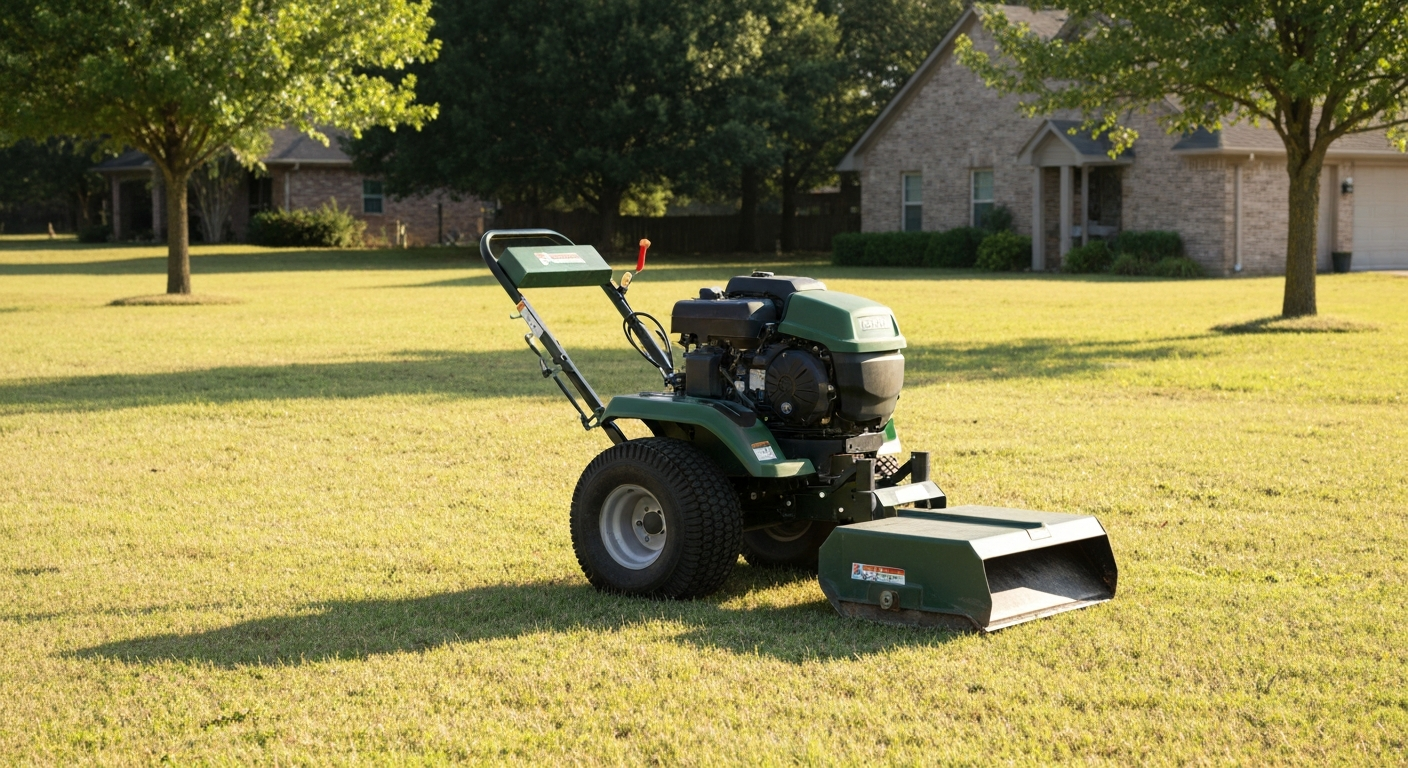
- Commercial mower: $3,000–$12,000. A residential mower will not hold up. A commercial walk-behind or zero-turn from Husqvarna, Exmark, or Scag is the baseline. Used is fine if you know what you’re buying.
- Trailer (enclosed or open landscape): $1,000–$5,000
- Handheld equipment — trimmers, edgers, backpack blower: $500–$2,000
- Vehicle (truck or van): $5,000–$20,000. Used is common at startup. Just make sure it can handle the trailer.
Insurance
- General liability insurance: $1,000–$4,000/year depending on revenue, services, and carrier. This is separate from the liability insurance required for pesticide applicators. You need general liability regardless.
- Workers’ comp: additional cost once you hire
Total lean startup (mow-only, used equipment, one person) Realistically $5,000–$15,000 if you already have a truck or buy one at the lower end. The biggest variable is equipment — buying used commercial gear versus new changes the math significantly.
If you’re adding pesticide services from day one, add the ODAFF license cost and factor in the higher insurance requirements. You’ll also want a dedicated sprayer setup, which runs $300–$1,500 depending on type.
A Few Things Worth Getting Right Early
Insurance before equipment, not after. A lot of people buy the mower first and figure out insurance later. Get your general liability policy in place before you take a single paying job. One damaged irrigation system or cracked window from a rock and you’ll understand why.
Keep your certifications current. The ODAFF pesticide license renews annually. Mark your renewal date and don’t let it lapse — applying pesticides with an expired license carries the same legal exposure as operating without one. ODAFF enforces this.
Price for the full cost of the business. Workers’ comp, insurance, equipment maintenance, fuel, and the time you spend on admin all need to be factored into your pricing. The biggest mistake new lawn care operators make is pricing based on what the competition charges without knowing whether that competitor is actually profitable — or even properly insured.
Talk to your city clerk before you start marketing. Some municipalities require additional permits for commercial vehicles parked in residential areas or for operating a business with a home address. Better to know upfront.
Next Steps
If you’re starting mow-only, the path is short: form your LLC at sos.ok.gov, get your city business license, buy or lease your equipment, and get a general liability policy in place. You could be legally operating within a week or two.
If pesticide services are part of your plan from the start — or something you want to add in year one — order the ODAFF study materials now and schedule your exams. The certification-to-license process takes time, and you can’t legally spray until the actual license is issued, not just the certification card. Plan that timeline before you start promising customers weed control.
Contact ODAFF’s Pesticide Division directly with questions about categories, exam scheduling, and insurance requirements. Their website is the authoritative source — requirements and fees can update, and the exam scheduling process is specific enough that you want to hear it from them directly.
The Oklahoma lawn care market has real demand, especially in the OKC metro and Tulsa suburbs where growth has outpaced the supply of reliable, professional operators. Getting the legal foundation right from the start puts you ahead of a lot of competition that never bothered.