How to Start a Fitness Studio or Gym Business in Oklahoma
How to Start a Fitness Studio or Gym Business in Oklahoma
Oklahoma is one of the best states in the country to open a gym. Not because of any special incentive program or tax break — just because the state mostly stays out of your way. No state health club registration. No membership contract filing. A $100 LLC. Commercial space that costs a fraction of what you’d pay in Austin or Denver. If you’ve been putting off going legit with a fitness business, Oklahoma’s regulatory environment is genuinely about as simple as it gets.
Here’s what you actually need to do, what it costs, and where the real compliance requirements live.
Licensing Requirements
No State Health Club Registration
Many states have a Health Spa Act or Health Club Act that requires fitness businesses to register with a state agency, post bonds, file membership contract templates, and jump through a series of hoops before they can sell a single membership. Oklahoma has none of that.
There is no Oklahoma state health club registration. No state agency you need to contact before opening. No membership contract filing requirement at the state level. You don’t need to post a surety bond with the state. You don’t need to submit your membership agreement to anyone for approval.
That’s not a loophole — it’s just how Oklahoma’s regulatory structure works for gyms and fitness studios. The state has chosen not to regulate this industry at the state level, which means your regulatory obligations are entirely local.
City Business License
Every city in Oklahoma handles business licensing differently. In Oklahoma City, you’ll apply through the city’s Planning Department for a business license. In Tulsa, it runs through the City Clerk’s office. Most cities charge between $20 and $100 for a basic business license, and some require annual renewal.
Contact your city’s business licensing office before you sign a lease. Requirements vary by city, and a few municipalities have specific zoning categories for fitness facilities. Getting that conversation out of the way early saves you from signing a lease on a space that won’t get zoned properly.
Certificate of Occupancy, Zoning, and Fire Inspection
This is where most of the local compliance actually lives — and it matters more for gyms than for most businesses.
Zoning approval. Gyms are typically classified as assembly or commercial recreation uses in municipal zoning codes. You need to confirm the space you’re eyeing is zoned for that use before you commit. A retail strip mall bay might be zoned for retail but not assembly, which affects your occupancy load and build-out requirements. Your city’s planning department can tell you whether a specific address works for a fitness facility, usually with a quick call or an online zoning map.
Certificate of Occupancy (CO). Before you open to the public, you need a CO from your city’s building department. This confirms the space meets building code requirements for its intended use. If you’re doing significant build-out — adding bathrooms, locker rooms, a group fitness room with mirrors — you’ll need permits for that work, and inspections will follow. Budget time for this. A straightforward build-out in a previously commercial space might take 4-6 weeks to permit and inspect. A full renovation can take longer.
Fire inspection. Commercial fitness spaces get inspected by the local fire marshal before opening. They’re checking sprinkler systems, emergency exits, occupancy load, fire extinguisher placement, and exit signage. Nothing exotic — but you need it cleared before you put members on the floor.
If you’re opening a boutique studio in an already-finished commercial suite, the CO and fire inspection process moves faster. If you’re converting a warehouse or a big-box retail space, give yourself more runway.
Oklahoma Cost Advantage
LLC Formation: $100 + $25 Per Year
Filing your LLC with the Oklahoma Secretary of State costs $100. That’s the Articles of Organization fee, filed at sos.ok.gov. After that, you pay a $25 annual certificate fee to keep the LLC in good standing.
No franchise tax. Oklahoma repealed its franchise tax in 2024. In California, every LLC pays a minimum $800 franchise tax annually — before it makes a single dollar. In Texas, LLCs under a certain revenue threshold avoid it, but larger operations pay. In Oklahoma, there’s no equivalent. The $25 annual fee is genuinely just an administrative fee.
For a gym owner, this matters over time. You’re running a capital-intensive business with significant equipment and lease obligations. Not having to write an $800+ check every year just for the privilege of existing as an LLC is real money.
Commercial Lease Rates
This is the biggest cost advantage Oklahoma offers. Commercial lease rates in Oklahoma run roughly $8 to $15 per square foot per year in most markets. In Oklahoma City and Tulsa, you’ll find gym-appropriate spaces — high-ceiling bays, former retail or light industrial — at the lower end of that range. Quality Class B retail with good parking and traffic can run toward $15/sq ft.
Compare that to California, where comparable commercial space in any metro area runs $20 to $60 per square foot per year. A 4,000 square foot gym that costs you $40,000-$60,000 per year in rent in Oklahoma City would run $80,000 to $240,000 in the Los Angeles suburbs. That’s not a rounding error — that’s the difference between a business that works and one that requires 800 members just to cover occupancy costs.
If you’re coming from a coastal city and you’ve been running numbers in your head wondering how gyms survive, Oklahoma’s lease rates are the answer.
Workers’ Compensation: Mandatory for All Employers
Here’s the compliance requirement that catches gym owners off guard: Oklahoma requires workers’ compensation coverage for all employers, regardless of how many employees you have. No minimum headcount. One employee? You need coverage.
Most states have a threshold — often 3, 4, or 5 employees — before workers’ comp kicks in. Oklahoma has no such threshold. The moment you hire a personal trainer, a group fitness instructor, or a front desk person, you’re required to carry workers’ compensation insurance.
This isn’t a dealbreaker — workers’ comp for a small fitness business typically runs a few hundred to a couple thousand dollars per year depending on payroll. But it’s a real line item in your budget, and owners who skip it face significant penalties. Get a quote from your business insurer when you start hiring. Don’t wait.
The Oklahoma Workers’ Compensation Commission oversees this requirement. If you’re starting as a solo operator with no employees, you’re not subject to the mandate yet — but plan for it once you start adding staff.
Labor Costs
Oklahoma follows the federal minimum wage of $7.25 per hour. The state has not enacted a higher state minimum wage. For a fitness business where front desk and floor staff are often part-time, this matters to your labor model. Group fitness instructors and personal trainers are typically paid on an hourly or per-class basis well above minimum wage, but the baseline labor cost structure in Oklahoma is lower than in states like Colorado ($14.42/hr) or California ($16/hr).
Combined with lower lease rates, this gives Oklahoma gym owners significantly more margin flexibility than operators in high-cost states.
Startup Costs
The Business Entity: $100 + $25/Year
Start here. File your LLC at sos.ok.gov for $100. You’ll also want an EIN from the IRS — free at irs.gov/ein — which you need to open a business bank account and handle payroll.
If you plan to sell memberships (you will), register for a sales tax permit with the Oklahoma Tax Commission through oktap.tax.ok.gov. The permit costs $20. Oklahoma’s state sales tax rate is 4.5%, but combined with local rates, you’ll typically collect 7-11% total. Whether gym memberships are taxable depends on what you’re selling — some fitness services are exempt, some aren’t. Talk to an Oklahoma CPA before you set your pricing, because getting this wrong creates headaches during tax season.
Equipment: $20,000–$100,000
The range here is wide because the type of gym you’re opening drives everything.
A boutique yoga or Pilates studio can get started with relatively modest equipment — mats, props, reformers if you’re doing Pilates, sound system, mirrors. You could outfit a 1,500 square foot studio for $20,000-$40,000 with new equipment, less if you buy quality used.
A functional fitness or CrossFit-style box needs barbells, plates, rigs, rowers, and flooring. Budget $30,000-$60,000 for a properly equipped 3,000 square foot space.
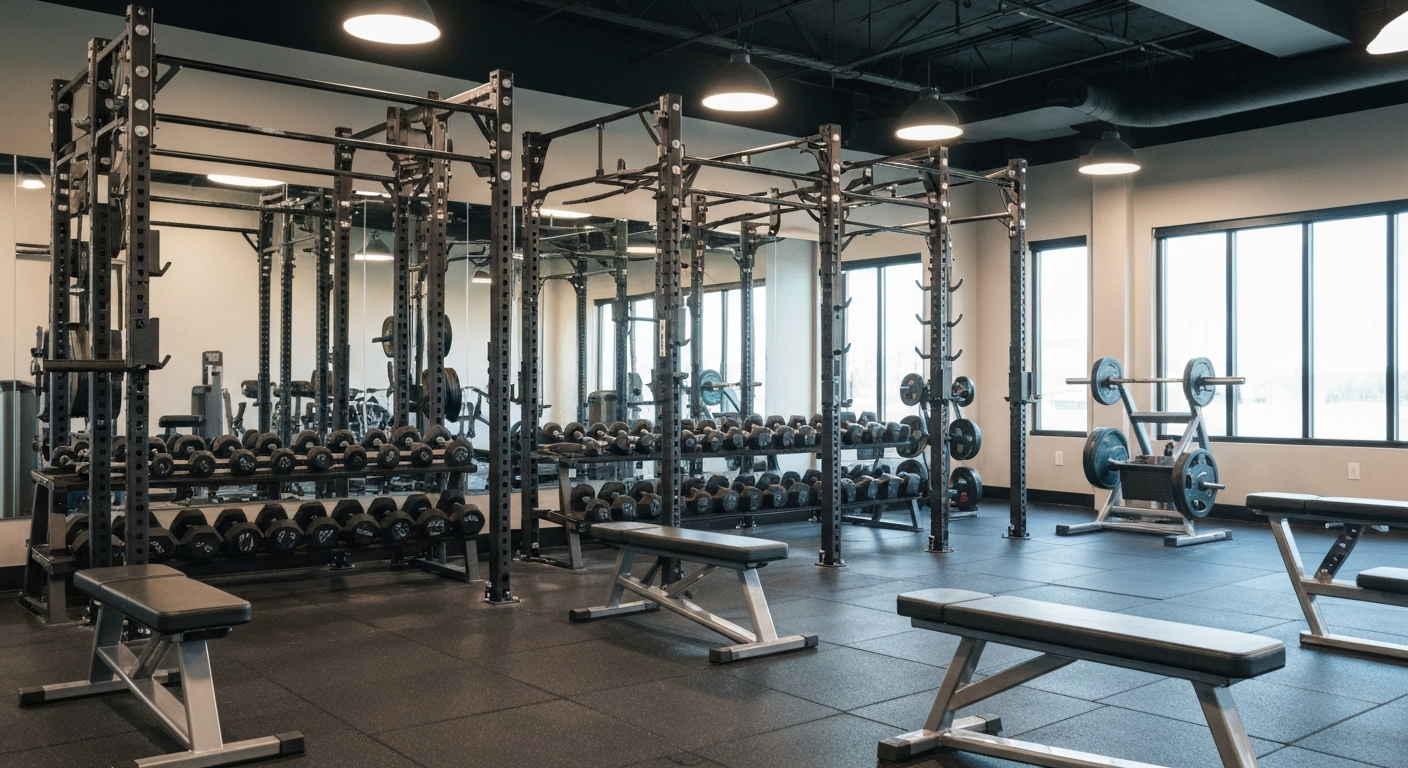
A full traditional gym with cardio equipment, selectorized machines, free weights, and a stretching area? Cardio equipment alone gets expensive fast. Treadmills run $1,500-$5,000 each new. Ellipticals, bikes, and rowers add up. A 5,000+ square foot traditional gym with 30-40 pieces of cardio and a full weight floor runs $60,000-$100,000 in equipment — and that’s buying smart, mixing new and quality refurbished.
Buying refurbished commercial equipment from reputable dealers is completely reasonable. Precor, Life Fitness, and Technogym all have certified refurbished programs. You can cut equipment costs by 30-50% without sacrificing quality.
Build-Out: $15,000–$100,000
Build-out costs depend heavily on the condition of the space and what you’re adding.
A clean commercial bay in good condition might need only flooring, mirrors, lighting upgrades, and some paint — call it $15,000-$30,000. Add locker rooms and showers, and you’re adding $20,000-$40,000. A full gut-renovation of a raw warehouse or former retail space with HVAC modifications, plumbing for bathrooms, and finish work can run $80,000-$100,000 or more.
Oklahoma construction labor costs are lower than national averages, which helps here. Get three bids from local commercial contractors. And negotiate tenant improvement allowances with your landlord — in Oklahoma’s commercial market, landlords often offer $10-$20 per square foot in TI allowance to land a good long-term tenant. That can cover a significant chunk of your build-out costs.
Insurance: $1,500–$4,000 Per Year
You need at minimum:
- General liability — covers member injuries, slip-and-fall claims, equipment accidents. Budget $800-$1,500/year for a small studio.
- Property insurance — covers your equipment and build-out if there’s a fire, theft, or weather event.
- Workers’ compensation — required once you hire anyone, as covered above.
Specialized fitness business insurers like K&K Insurance or Philadelphia Insurance offer gym-specific policies that bundle general liability and property. Once you add workers’ comp for staff, total annual insurance costs for a mid-size gym typically run $1,500-$4,000 per year. That’s a manageable line item — and skipping it isn’t an option.
Total Startup Cost Ranges
Boutique studio (yoga, Pilates, cycling, barre — under 2,500 sq ft): $30,000–$60,000. Lower equipment needs, simpler build-out, smaller footprint. This is where a lot of Oklahoma fitness entrepreneurs start.
Full-service gym (traditional or functional fitness, 4,000+ sq ft, multiple equipment categories): $80,000–$350,000. The wide range reflects the difference between a smart build with used equipment and a flagship location with new commercial gear and full locker room facilities.
Most first-time owners underestimate the build-out and overestimate how quickly they’ll hit break-even membership. Plan conservatively on both. Three to six months of operating reserves — rent, utilities, payroll, insurance — should be in the bank before you open the doors.
The short version: Oklahoma removes most of the state-level friction that makes gym ownership complicated in other states. Your compliance checklist is city business license, zoning confirmation, certificate of occupancy, and fire inspection. Your ongoing state obligations are $25/year and workers’ comp once you hire staff. The lease rates and labor costs give you a real structural advantage.
Get your LLC filed, lock down a space, and get your CO process started early. The physical build is usually what takes the longest — plan for that, and the rest falls into place.