How to Start a Dental Practice in Oklahoma
How to Start a Dental Practice in Oklahoma
Oklahoma is one of the cheapest states in the country to own and operate a dental practice. No franchise tax. A $100 LLC. Annual fees of $25. Lease rates and dental hygienist salaries that run 20-30% below national averages. The equipment costs are what they are — nobody’s selling you a dental chair at a discount because you’re in Tulsa — but the ongoing cost of keeping the lights on is genuinely lower here than in most states.
Here’s what you need to do.
Get Your Oklahoma Dental License
The Oklahoma Board of Dentistry handles licensing. Their site is dentistry.ok.gov — that’s where you’ll find current applications, fee schedules, and contact information if something in your specific situation needs a real conversation.
The requirements:
You need to graduate from an accredited dental school. That means a program accredited by the Commission on Dental Accreditation (CODA). If you went to a foreign dental school, the path is more complicated — contact the Board directly about your options.
You need to pass the National Board Dental Examination. Both Part I (biomedical sciences) and Part II (clinical sciences). If you’re a recent graduate, you’ve already cleared this hurdle or are working on it.
You need to pass a clinical examination. Oklahoma accepts scores from several regional and national clinical boards — CRDTS, CDCA, WREB, and others. Check the Board’s current list because accepted exams can change.
And then there’s the one that trips people up: the Oklahoma Dental Jurisprudence Examination. This is a state-specific exam on Oklahoma dental law and the rules governing dental practice in the state. It’s not the NBDE. It’s not your clinical board. It’s a separate requirement that every applicant for an Oklahoma dental license must pass. If you’re relocating from another state with an active license, you still have to take it.
The jurisprudence exam covers Oklahoma statutes and Board rules — scope of practice, supervision requirements for dental auxiliaries, record-keeping rules, informed consent requirements. Study the Oklahoma Dental Practice Act. The Board typically provides reference materials. Don’t skip the prep.
Specialty licensing follows a similar path but requires additional postgraduate training in your specialty and passage of any applicable specialty board exams. Contact the Board if you’re applying as a specialist.
DEA registration is separate from your dental license. If you plan to prescribe controlled substances — and most practices do — you’ll need a DEA registration number. Apply at dea.gov. Oklahoma also requires registration with the Oklahoma Bureau of Narcotics and Dangerous Drugs Control (OBNDD). Budget for both.
Set Up Your Business Structure
Most dental practices in Oklahoma form an LLC. Some form a professional corporation (PC) or professional limited liability company (PLLC) — the Oklahoma Board of Dentistry may have rules about which entity types are permissible for dental practices and who can own them, so confirm the current rules before you file. In many states, a dental practice must be owned by a licensed dentist. Oklahoma follows this general principle.
LLC formation: $100. File your Articles of Organization with the Oklahoma Secretary of State at sos.ok.gov. You can do it online. The state fee is $100. That’s the whole thing.
Annual Certificate: $25/year. Oklahoma requires an annual certificate to keep your LLC in good standing. Twenty-five dollars. Compare that to California’s $800 annual franchise tax minimum — which you owe even in your first year, even if the practice made nothing. Oklahoma repealed its franchise tax in 2024, so there’s no equivalent here. That’s real money over time.
EIN. Get your Employer Identification Number from the IRS at irs.gov/ein. Free. Takes about five minutes online. You need this before you open a business bank account or hire anyone.
City business license. Oklahoma has no statewide business license, but most cities require a local one. Oklahoma City, Tulsa, Norman, Broken Arrow — each has its own process and fee. Contact your city directly. This is usually quick and inexpensive, often under $100.
Zoning. Before you sign a lease or buy property, verify that the location is zoned for medical or professional office use. Your city’s planning department handles this. A dental practice in a retail strip might require a special use permit. Find out before you’re locked into a lease.
Workers’ compensation insurance. Oklahoma requires workers’ comp coverage for all employers — no minimum employee count. You hire one dental assistant, you need it. You hire a front desk person part-time, you need it. There’s no exception for small practices. Get coverage before your first employee starts.
Professional liability (malpractice) insurance. Required by any sensible lender and most commercial landlords. More on the cost below.
Startup Costs
Let’s be direct: starting a dental practice from scratch is expensive no matter where you do it. Equipment is equipment. But Oklahoma’s lower real estate costs and labor market make the ongoing economics significantly more favorable than coastal markets. Here’s what you’re looking at.
LLC and State Fees
$100 to form the LLC. $25/year to keep it active. That’s your entire state business overhead. Add a few hundred for a registered agent service if you don’t have a physical office address yet, though most dentists opening a practice will use the practice address.
Equipment
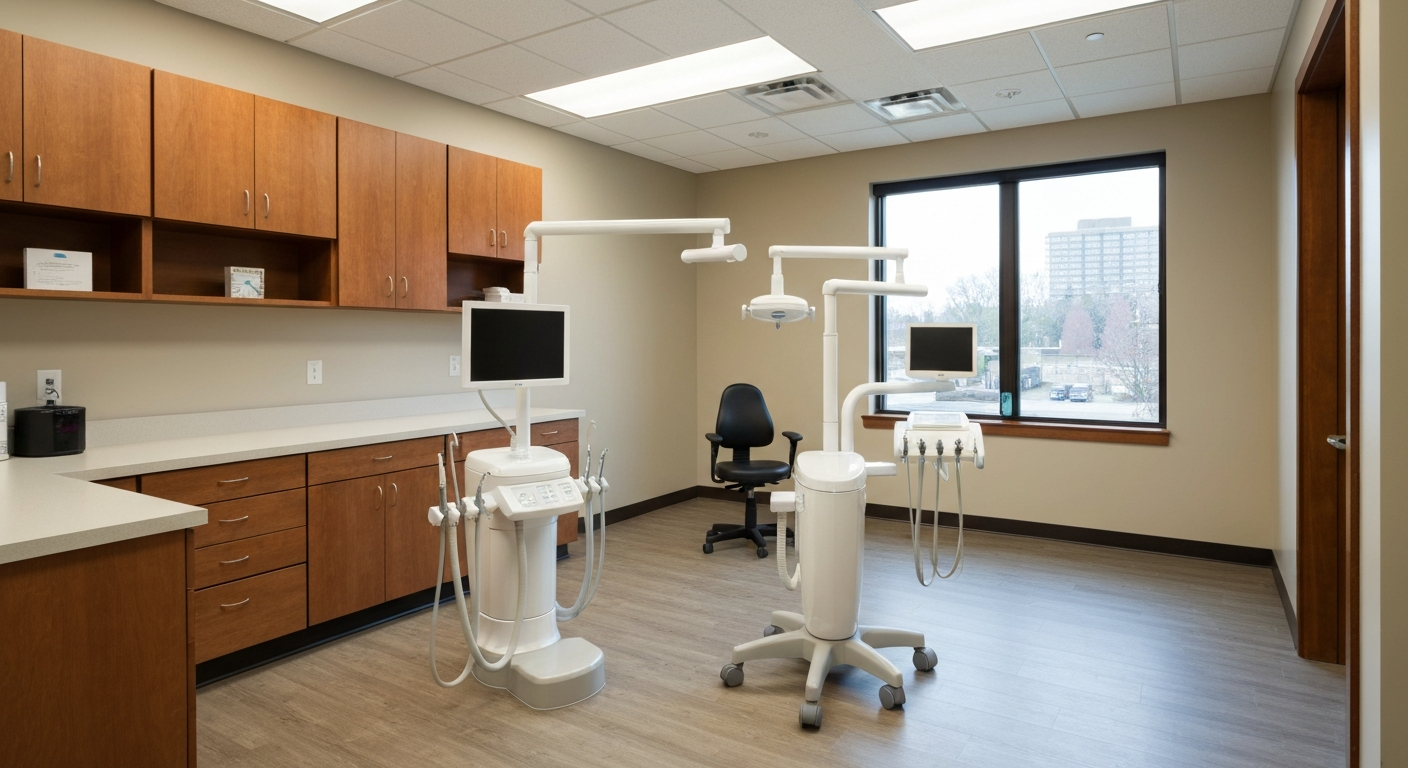
$150,000 to $300,000. This is the unavoidable number. Dental chairs, delivery units, X-ray equipment (including digital sensors or a panoramic unit), sterilization equipment, compressors, vacuum systems, cabinetry — it adds up fast. A two-operatory startup can land near the low end. A four-operatory build-out with a CBCT unit pushes toward the high end or beyond.
Financing is normal and expected. Most practice lenders — Bank of America Practice Solutions, TD Bank, and several dental-specific lenders — will finance up to 100% of a startup for a licensed dentist with reasonable credit and a solid business plan. Interest rates and terms vary, but dental practices have strong loan approval rates because the failure rate for dental startups is historically low.
Build-Out
$75,000 to $200,000. Construction costs are real, but Oklahoma commercial construction and contractor labor runs meaningfully lower than in Denver, Austin, or most of the Pacific Coast. You’re not building a hospital — you’re running plumbing and electrical to operatories, installing cabinetry, and finishing a waiting room. The per-square-foot cost for commercial build-out in Oklahoma City and Tulsa markets is competitive.
Some landlords in Oklahoma will offer tenant improvement allowances — money toward build-out in exchange for a longer lease. In a market where dental practices are desirable tenants (they sign long leases, they’re stable, they don’t cause noise or traffic problems), you have negotiating leverage. Push for it.
Technology
$20,000 to $60,000. This covers your practice management software (Dentrix, Eaglesoft, Open Dental, or similar), digital X-ray sensors, intraoral cameras, and your IT infrastructure — computers, networking, a HIPAA-compliant server setup or cloud solution. If you add CAD/CAM (in-house crown milling), you’re looking at another $80,000-$150,000 on top of this range. Most startups skip CAD/CAM initially and add it later.
HIPAA compliance isn’t optional. You need a signed Business Associate Agreement with your software vendor and any cloud storage provider. You need a Security Risk Analysis done before you open. Budget $500-$2,000 for an IT consultant to set this up properly if you’re not technically confident.
Insurance
$4,000 to $12,000 per year. This covers professional liability (malpractice), general liability, property insurance, and business interruption coverage. Malpractice rates for general dentists in Oklahoma are lower than in high-litigation states. A solo general dentist in Oklahoma might pay $2,500-$4,000/year for malpractice alone. Add the other coverages and you’re in the $4,000-$12,000 range total depending on your practice size, location, and coverage limits.
Also budget for overhead disability insurance — this pays your practice expenses if you can’t work. It’s separate from personal disability. Most lenders quietly expect you to have it.
Working Capital
Not on the startup equipment checklist, but don’t skip it. You need 3-6 months of operating expenses in reserve. Supplies, payroll, rent, utilities — before collections ramp up, you’re spending money you haven’t collected yet. Most dental practices don’t break even until month 6-12. Some lenders will include a working capital line in the startup loan. Use it.
Total Estimate
$250,000 to $600,000 for a full startup — equipment, build-out, technology, and working capital. That range is wide because a two-operatory leased space in a mid-size Oklahoma city and a four-operatory owned building with a CBCT are different projects.
Oklahoma doesn’t change the equipment number much. But lower lease rates, lower construction costs, and lower dental hygienist salaries (averaging around $60,000-$70,000 in Oklahoma vs. $80,000-$100,000 in California or Washington) change the monthly overhead picture significantly. A practice that’s barely profitable in San Francisco might throw off solid income in Edmond.
Oklahoma’s Cost Advantage — The Real Numbers
No franchise tax saves you money every single year. California dentists pay $800 minimum even in lean years. Texas has no income tax but levies a franchise tax on gross receipts. Oklahoma has neither. For a practice generating $800,000 in collections, the difference in annual state business overhead is meaningful.
State income tax in Oklahoma tops out at 4.75% — not zero, but far below California’s 13.3% top rate. Corporate tax is 4%. These aren’t the deciding factor in where to open a practice, but they’re not nothing.
Commercial lease rates in Oklahoma City and Tulsa markets run $18-$28 per square foot annually for professional office space. Comparable space in Phoenix runs $28-$38. Los Angeles, $45-$65. A 2,000 square foot dental suite is $36,000-$56,000/year in OKC versus $90,000-$130,000 in LA. That’s $40,000-$70,000 a year in extra rent — every year — that an Oklahoma dentist doesn’t pay.
The tribal jurisdiction issue in eastern Oklahoma (from McGirt v. Oklahoma) affects criminal law enforcement primarily, but if you’re opening in that part of the state, talk to a local attorney about any business implications for your specific location. Most dental practices aren’t affected, but it’s worth a quick conversation if you’re setting up in the eastern part of the state.
The Practical Sequence
Once you have your license and entity sorted, here’s the order that makes sense:
1. Get your dental license finalized first. Don’t sign a lease until you know your license is approved or imminent. The jurisprudence exam, DEA registration, and Board application take time. Start early.
2. Form your LLC (or PLLC) with the SOS. File at sos.ok.gov. Get your EIN from the IRS. Open a business bank account.
3. Find your location. Work with a commercial real estate broker who has experience with medical/dental tenants. They understand build-out negotiations and can help you find spaces with favorable lease terms. Their fee comes from the landlord, not you.
4. Secure financing. Dental practice lenders move faster when you have a location under letter of intent and a business plan. Get pre-qualified early so you’re not waiting on money while your build-out timeline slips.
5. Hire a dental equipment specialist. Most major suppliers (Patterson, Henry Schein, Benco) have Oklahoma reps who do office design and equipment installation. They’ve done dozens of Oklahoma startups. Use their experience.
6. Get your city business license and workers’ comp coverage before you open.
7. Hire your team. Credentialing with insurance plans takes 90-120 days. Start the credentialing process before you open the doors, or you’ll be seeing patients for cash only for your first few months.
Start at the Board
Everything flows from your dental license. Before you look at real estate, before you research equipment, go to dentistry.ok.gov and read the current licensure requirements. Confirm the accepted clinical exams, get the jurisprudence exam materials, and verify the application timeline. The Board is reachable by phone if you have questions specific to your situation.
Oklahoma’s low overhead costs and strong rural dental shortage areas (which may qualify you for loan repayment programs through the Oklahoma State Department of Health) make this a genuinely attractive state to practice in. The business side is straightforward. The jurisprudence exam is manageable. The equipment costs are what they are everywhere.
Get licensed. Form your LLC. Find your location. Then build.