How to Start a Coffee Shop in Oklahoma
How to Start a Coffee Shop in Oklahoma
Oklahoma issues no statewide business license, repealed its franchise tax in 2024, and has commercial rents that make coastal coffee shop owners weep with envy. The regulatory path is genuinely manageable. But a coffee shop is still a capital-heavy business that lives or dies on one variable: foot traffic. This guide covers both sides — the licensing steps and the business reality — so you can make an informed decision before you sign a lease.
Why Open a Coffee Shop in Oklahoma?
The specialty coffee scene here isn’t a trend anymore. OKC has Elemental Coffee and Chimera. Tulsa has Topeca. Both cities have built genuine independent coffee cultures with loyal customer bases who actively choose local over chain. That’s the market you’re entering — and there’s room in it, especially as the scene expands beyond the metros.
The numbers help, too. Retail commercial space in OKC runs $12–$22 per square foot annually. Tulsa is $10–$18. Compare that to Austin, Denver, or Portland, where you’re paying $35–$60+ for comparable space. Lower rent means your break-even is lower, which matters enormously in a business where your average ticket is $6–$8.
Coffee is one of the better-margin products in food service. Espresso drinks run 65–80% gross margin — the milk and syrup cost on a $5.50 latte is maybe $0.80. That margin is what funds everything else. A mid-size coffee shop doing $400,000 in annual revenue can actually work in Oklahoma at rent levels that would be impossible in a coastal market.
Beyond the metros, there’s a different opportunity: smaller Oklahoma cities often have no real independent coffee shop at all. In those markets, a well-run shop becomes the default community gathering space — morning meetings, remote workers, weekend regulars. Less competition, but also a smaller customer pool. You’ll need to weigh both.
And yes — no franchise tax since January 1, 2024 (HB 1039), and no statewide general business license. Those aren’t reasons to open a coffee shop, but they’re costs you don’t have to plan around.
Step 1: Choose Your Business Structure
File an LLC. For a coffee shop, this isn’t optional advice — it’s baseline protection.
Hot beverage burns are real liability. Slip-and-fall claims happen in wet café environments. If you’re serving any food on-site, foodborne illness is a tail risk. An LLC separates your personal assets from the business. It costs $100 to file online at sos.ok.gov, and $25 per year for the Annual Certificate. That’s the cheapest insurance you’ll buy.
If you’re opening with a partner or co-founder, you need an operating agreement. Not because Oklahoma requires it for LLCs, but because “we’ll figure it out later” is how partnerships dissolve badly. The agreement should define who owns what percentage, who makes day-to-day decisions, how profits are distributed, and what happens if one person wants out. Get this in writing before you spend a dollar on equipment.
Solo founder? You still want the LLC. The operating agreement is less urgent, but the liability protection is the same.
Step 2: Find Your Location and Plan Review
This is the most important decision you’ll make. Full stop.
A mediocre coffee shop in a great location will outperform a great coffee shop in a mediocre location, almost every time. Foot traffic, parking, visibility, and proximity to offices, universities, or dense residential areas are what drive revenue. Before you fall in love with a space, count the actual foot traffic at different times of day. Sit outside for an hour on a Tuesday morning and a Saturday morning. Watch who walks by and where they’re going.
Before you sign anything, verify the zoning with the city or county planning department. A space needs to be commercially zoned for food service use. Some mixed-use or light commercial zones have restrictions. Find this out before you negotiate a lease, not after.
Once you have a location, you’ll submit plans to your county health department for plan review. The fee is $425. This isn’t optional — it’s required before you can open a food establishment in Oklahoma.
Your plans need to show:
- The espresso bar layout and equipment placement
- Food prep area (if you’re serving anything made on-site)
- Plumbing: a three-compartment sink for washing, rinsing, and sanitizing equipment, plus a dedicated handwash station
- Ventilation
- Storage areas (dry, refrigerated, chemical storage — separately)
- Seating layout
If you’re renovating a space — and most coffee shop build-outs involve at least some renovation — you’ll need building permits from the city. When the work is done, you need a Certificate of Occupancy before you can open. This is the city’s sign-off that the space is safe and built to code.
ADA compliance is required. That means an accessible entrance, accessible restrooms, and counter height that accommodates customers in wheelchairs. If you’re building a new counter, design for this from the start — retrofitting is more expensive.
Step 3: Get Your OSDH Food Establishment License
This surprises some people: even if you’re only serving brewed coffee and prepackaged pastries, Oklahoma classifies your coffee shop as a food service establishment. That means you need a license from the Oklahoma State Department of Health (OSDH).
The OSDH Food Establishment License costs $425 for a new establishment and $335 per year at renewal. You’ll also go through a pre-licensure inspection — an OSDH inspector visits the space to verify it matches your approved plans and meets food safety standards. Don’t schedule your soft opening until you’ve passed that inspection.
Every employee who prepares or serves beverages or food needs a food handler permit. Oklahoma law requires this within 30 days of hire, and the maximum cost is $15 per permit. If you’re hiring three baristas at launch, budget $45 for food handler permits. It’s not a major expense, but it’s a legal requirement and you need to build it into your onboarding process.
If you serve food prepared on-site — house-made pastries, breakfast sandwiches, avocado toast — full food service requirements apply. That means more equipment requirements, more careful temperature control documentation, and more scrutiny during inspections. Not impossible, but the jump from “coffee and prepackaged items” to “full food prep” is meaningful.
OSDH website: oklahoma.gov/health
Step 4: Alcohol Licensing (If Applicable)
Not every coffee shop needs a liquor license. But the beer-and-wine café concept is gaining real traction in Oklahoma, and it’s worth thinking through before you finalize your concept.
The model: specialty coffee in the morning and afternoon, craft beer and wine by evening. One space, two revenue streams, extended hours. It works particularly well in walkable neighborhoods where the customer base overlaps — the person who gets a pour-over at 8am might come back for a glass of wine at 7pm.
A beer and wine license from the ABLE Commission costs $525 initially and $450 per year to renew. If you want to add cocktails and spirits, a mixed beverage license is $1,030 initially and $905 per year.
Be realistic about what alcohol adds, though. It’s not free money. Your insurance costs go up — you’ll need liquor liability coverage. Staffing gets more complicated because servers need training under Oklahoma’s ABLE requirements. And the operational complexity of running a bar program, even a simple one, is real. If your concept is primarily coffee and alcohol is a secondary addition, the beer-and-wine license is manageable. If you’re trying to run a serious cocktail program out of a coffee shop, that’s a different business.
Step 5: Register for State Taxes
Register through OkTAP — Oklahoma’s Taxpayer Access Point. You need a Sales Tax Permit, which costs $20 plus a handling fee.
Coffee and food sold in your shop are subject to Oklahoma sales tax: 4.5% state base plus local rates. Total effective rates typically run 7–11% depending on your city and county. You’re collecting at the destination — the rate where your customer is buying, which for a brick-and-mortar shop is always your location’s rate. You’ll file and remit sales tax through OkTAP on a regular schedule.
If you’re hiring staff — and you will be if you’re running a real coffee shop — register for employer withholding through the same OkTAP portal. You’ll withhold Oklahoma income tax from employee paychecks and remit it to the Oklahoma Tax Commission.
Workers’ compensation insurance is mandatory the moment you hire your first employee. No minimum employee threshold in Oklahoma. Coffee shops have genuine burn and slip-and-fall risks, so this isn’t a box-checking exercise — it’s actual risk management. More on the insurance picture in Step 7.
Get your EIN from the IRS first — free at irs.gov/ein. You’ll need it for OkTAP registration and everything else.
Step 6: Equipment and Build-Out
This is where the capital requirement gets real.
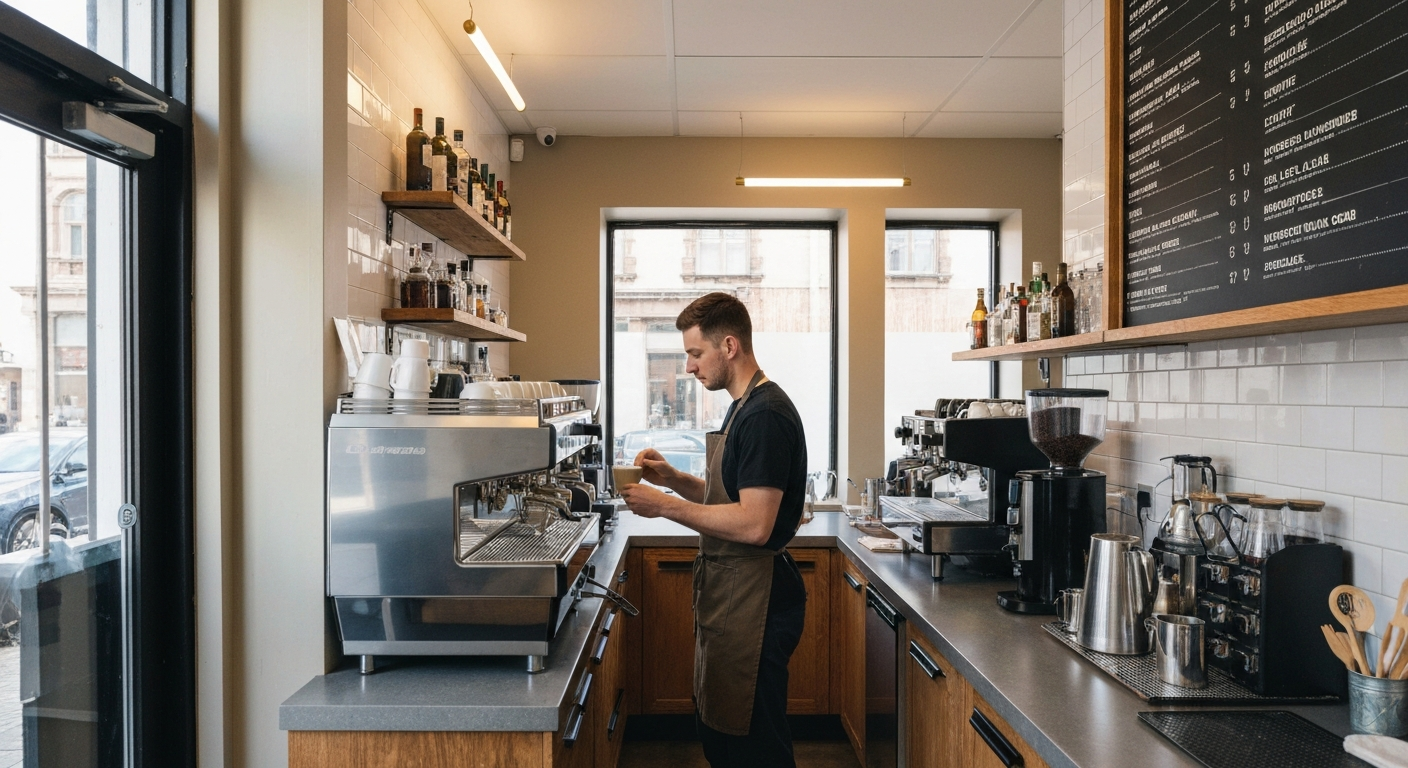
Your espresso machine is the heart of the operation. A commercial two-group machine — the standard for a shop doing real volume — runs $5,000 to $20,000+. La Marzocca, Nuova Simonelli, and Rancilio are the brands you’ll see in serious Oklahoma shops. Don’t buy a prosumer machine and hope it survives a busy Saturday. It won’t.
Grinders matter as much as the machine. Budget $500–$2,500 per grinder, and you need at least two — one dedicated to espresso, one for drip or pour-over. Grinder quality directly affects extraction consistency, which directly affects cup quality.
Beyond espresso: a batch brewer ($200–$1,500), pour-over station ($100–$500), and cold brew system ($200–$500) if you’re doing cold brew in-house. Commercial refrigeration — under-counter and reach-in units — runs $1,000–$5,000.
A POS system designed for coffee shops (Toast, Square for Restaurants, Lightspeed) costs $1,000–$3,000 to set up plus monthly software fees. Don’t use a basic retail POS — you need modifier support for drink customization and reporting that tracks beverage-level margins.
Furniture and fixtures — tables, chairs, the counter itself, shelving, lighting — run $5,000–$20,000 depending on how much you’re building versus buying used. The aesthetic of your space matters for Instagram, yes, but more importantly it affects how long customers stay and whether they come back.
Build-out is the wildcard. Plumbing, electrical, HVAC, and flooring in a raw or partially finished space can run $20,000–$80,000. If you find a space that was previously a café or restaurant, you can potentially inherit usable infrastructure and cut that number significantly. Finding a former café space is worth paying slightly higher rent for — the savings on build-out usually more than compensate.
Step 7: Insurance
You need several policies. Budget $1,500–$4,000 per year total, varying by coverage and whether you’re serving alcohol.
General liability: $800–$2,000/year. Covers customer injury claims, slip-and-fall, and general third-party property damage. This is the baseline.
Product liability: Covers foodborne illness claims and burn injuries from your products. Often bundled into a general liability policy for food service businesses — confirm with your broker that product liability is explicitly included.
Workers’ comp: Mandatory for all employees. Rates vary by payroll and risk classification. Coffee shop workers are classified at a moderate risk level — burns are the primary concern.
Property insurance: Covers your equipment, fixtures, and tenant improvements. Your espresso machine alone may be worth $10,000–$20,000. Don’t skip this.
Business interruption: Covers lost income if you have to close temporarily — equipment failure, fire, flood. Easier to justify after you’ve seen what three weeks of lost revenue looks like.
Liquor liability: Required if you’re serving alcohol. $500–$1,500/year. Your ABLE Commission license may require proof of this coverage.
Work with a broker who has food service clients. Generic small business policies sometimes have exclusions that matter a lot in a café environment.
Startup Costs at a Glance
Here’s what you’re actually looking at to open a coffee shop in Oklahoma:
| Item | Estimated Cost |
|---|---|
| Lease deposit + first/last month | $3,000–$15,000 |
| Build-out and renovation | $20,000–$80,000 |
| Equipment (espresso, brewing, refrigeration) | $10,000–$30,000 |
| Furniture and fixtures | $5,000–$20,000 |
| OSDH license + plan review | $850 (first year) |
| LLC filing | $100 + $25/year |
| Sales Tax Permit | $20 |
| ABLE Commission beer/wine license (if applicable) | $525 (first year) |
| Insurance (first year) | $1,500–$4,000 |
| Initial inventory (coffee, milk, syrups, food) | $2,000–$5,000 |
| Working capital (first 3 months) | $15,000–$50,000 |
| Total | $80,000–$300,000 |
The range is wide because the variables are wide. A small kiosk buildout in an existing commercial space is a different project than a full café renovation of a raw retail shell.
The licensing fees specifically — OSDH, LLC, Sales Tax Permit — run approximately $1,000–$2,000 for your first year before insurance. Oklahoma’s regulatory costs are not the obstacle here. The capital requirement for equipment and build-out is the obstacle.
One honest note: coffee shops require active, present management. The owner-operator who’s in the shop most mornings, knows the regulars, and trains baristas consistently is the model that works. The “hire a manager and collect revenue” model fails more often than not, especially in the first two years. If you’re planning to open a coffee shop as a side project while working full-time elsewhere, think carefully about whether you can give it what it actually needs.
The Location Question
It deserves its own emphasis, separate from the build-out section.
Most coffee shops that fail don’t fail because of bad coffee or bad licenses. They fail because they’re in the wrong spot — a block off the main street, in a strip mall with no walk-by traffic, or in a neighborhood that sounds promising but doesn’t have the density to support $300,000+ in annual beverage sales.
Before you commit to a location, know your numbers: how many customers per day do you need to break even? At a $7 average ticket, you need roughly 115 transactions per day to hit $300,000 in annual revenue. Is the foot traffic at your potential location plausibly going to generate 115 paying customers on a Tuesday? Be honest with yourself.
Oklahoma’s lower rents are a real advantage, but they don’t eliminate the fundamental math of a coffee shop. They just move the threshold down a bit.
Next Steps
Start with the location search and the LLC filing — those two things can happen in parallel. File your LLC at sos.ok.gov. Get your EIN at irs.gov/ein. Once you have a space under letter of intent, engage your county health department for plan review guidance before you finalize your build-out plans — changes after the fact are expensive. The OSDH license application comes after your plan review is approved and your build-out is complete.
The Oklahoma Secretary of State can be reached at 421 NW 13th Street, Suite 210, Oklahoma City, OK 73103, or (405) 521-3912 if you have entity filing questions.
The regulatory path is clear and the costs are manageable. The harder work is finding the right space, building the right concept for that location, and showing up every day to run it well.