How to Start a Chiropractic Practice in Oklahoma
How to Start a Chiropractic Practice in Oklahoma
Oklahoma has roughly one chiropractor per 2,500 residents — below the national average — which means real demand, especially in mid-size cities and rural communities that are chronically underserved. If you’ve finished school and passed your boards, the path from licensed chiropractor to practice owner in Oklahoma is more affordable than in most states. Lower rents, no franchise tax, and equipment costs running 20-30% below coastal markets make the math work for a lot of practitioners who’d struggle to get started in California or the Northeast.
Here’s what you actually need to do.
Get Your Oklahoma Chiropractic License
Before you sign a lease or buy a single piece of equipment, you need to be licensed by the Oklahoma Board of Chiropractic Examiners (OSBCE). Their website is osbce.ok.gov, and that’s where you’ll find current application requirements, fees, and forms.
Degree Requirement
You must have graduated from a chiropractic college accredited by the Council on Chiropractic Education (CCE). This is the standard accreditation body for chiropractic programs in the U.S. If your school holds CCE accreditation, you’re eligible to apply. If it doesn’t — even if it’s a legitimate school in another country — you’ll have a harder road and should contact the OSBCE directly before assuming you qualify.
NBCE Exams
Oklahoma requires passage of the National Board of Chiropractic Examiners (NBCE) exam sequence. The NBCE is divided into multiple parts:
- Part I — Basic sciences (anatomy, physiology, microbiology, pathology, etc.)
- Part II — Clinical sciences (diagnosis, chiropractic principles, spinal anatomy)
- Part III — Case management and clinical practice
- Part IV — Practical skills (the practical exam with radiograph interpretation and chiropractic technique)
- Physiotherapy — Required if you want to use physiotherapy modalities in practice
Most graduates sit these during and just after chiropractic school. If you’re already licensed in another state, you’ve almost certainly completed the NBCE sequence, but confirm with OSBCE what documentation they require.
Oklahoma Jurisprudence Exam
This is the one people forget about. Oklahoma requires a state jurisprudence exam on top of the national boards. It covers Oklahoma-specific laws, rules, and ethics governing chiropractic practice — scope of practice, record-keeping requirements, advertising rules, that kind of thing. It’s not a trick exam, but you do need to study the Oklahoma statutes and OSBCE rules before sitting for it.
Don’t skip this step or treat it as an afterthought. Your application won’t be approved without it.
Continuing Education and License Renewal
Once licensed, Oklahoma chiropractors must complete continuing education hours to renew. Check the OSBCE website for the current renewal schedule and CE requirements — these details change periodically and the board’s site will always have the current version.
If you’re already licensed in another state and want to practice in Oklahoma, contact the OSBCE about endorsement. Many states have reciprocity or endorsement pathways that can streamline the process, but Oklahoma’s board makes that determination case by case.
Set Up Your Practice Structure
Getting your chiropractic license is the professional piece. The business piece runs parallel — and Oklahoma makes it genuinely cheap to set up.
Form an LLC
Most chiropractors in solo or small practice use an LLC. It separates your personal assets from business liabilities, gives you flexible tax treatment, and signals to patients and vendors that you’re operating as a real business.
In Oklahoma, filing an LLC costs $100 at sos.ok.gov. After that, you pay a $25 annual certificate fee to keep the LLC in good standing. That’s it.
Oklahoma repealed its franchise tax in 2024. If you’ve heard horror stories from Texas or California about annual franchise taxes eating into small practice revenue — that’s not your problem here. An Oklahoma LLC costs you $100 to start and $25 a year to maintain. Hard to beat.
You’ll also need an EIN (Employer Identification Number) from the IRS, which you get free at irs.gov/ein. You need this to open a business bank account, hire staff, and handle payroll.
City Business License
Oklahoma has no statewide general business license. But your city almost certainly does. Oklahoma City, Tulsa, Broken Arrow, Edmond, Norman — every major city has its own licensing and zoning requirements. Check with your city’s business licensing office before you sign a lease to confirm your chosen location is zoned for a healthcare or professional services office.
Some cities process these in a few days. Others take a few weeks. Don’t assume it’s automatic.
Professional Liability (Malpractice) Insurance
You need malpractice insurance before you see your first patient. Not after — before. Most commercial lenders, landlords of medical office spaces, and billing platforms will ask for a certificate of insurance as part of their requirements anyway.
Oklahoma has a relatively favorable malpractice climate for chiropractic — costs are lower here than in states with more aggressive tort environments. Expect to pay somewhere in the $2,000-$4,000/year range for a solo practitioner policy, though the exact premium depends on your coverage limits, practice volume, and the carrier.
Workers’ Compensation Insurance
Oklahoma requires workers’ compensation coverage for all employers, with no minimum employee count. The moment you hire your first front-desk person or chiropractic assistant, you’re legally required to carry workers’ comp. This applies even if that person is part-time.
Don’t treat this as optional. Oklahoma’s workers’ comp requirement has no threshold exception. Get a policy before your first hire.
Business Bank Account
Open a dedicated business checking account using your EIN and LLC documents. Mixing personal and business finances makes bookkeeping a mess, complicates taxes, and can theoretically pierce your LLC’s liability protection in a dispute. Keep them separate from day one.
Understand Your Startup Costs
Oklahoma’s cost advantage is real, and it shows up in every line of a practice startup budget. Here’s a realistic breakdown.
LLC Formation: $100 + $25/year
Already covered above. The cheapest line item on your entire startup budget, and one of the few business costs with a precise number.
Equipment: $15,000–$60,000
Your equipment spend depends heavily on whether you’re buying new or refurbished and what your practice focus will be.
On the lower end ($15,000–$25,000): A lean startup with one or two used chiropractic tables, basic diagnostic tools, a cervical traction unit, and minimal therapy equipment. Viable for a solo practitioner starting out.
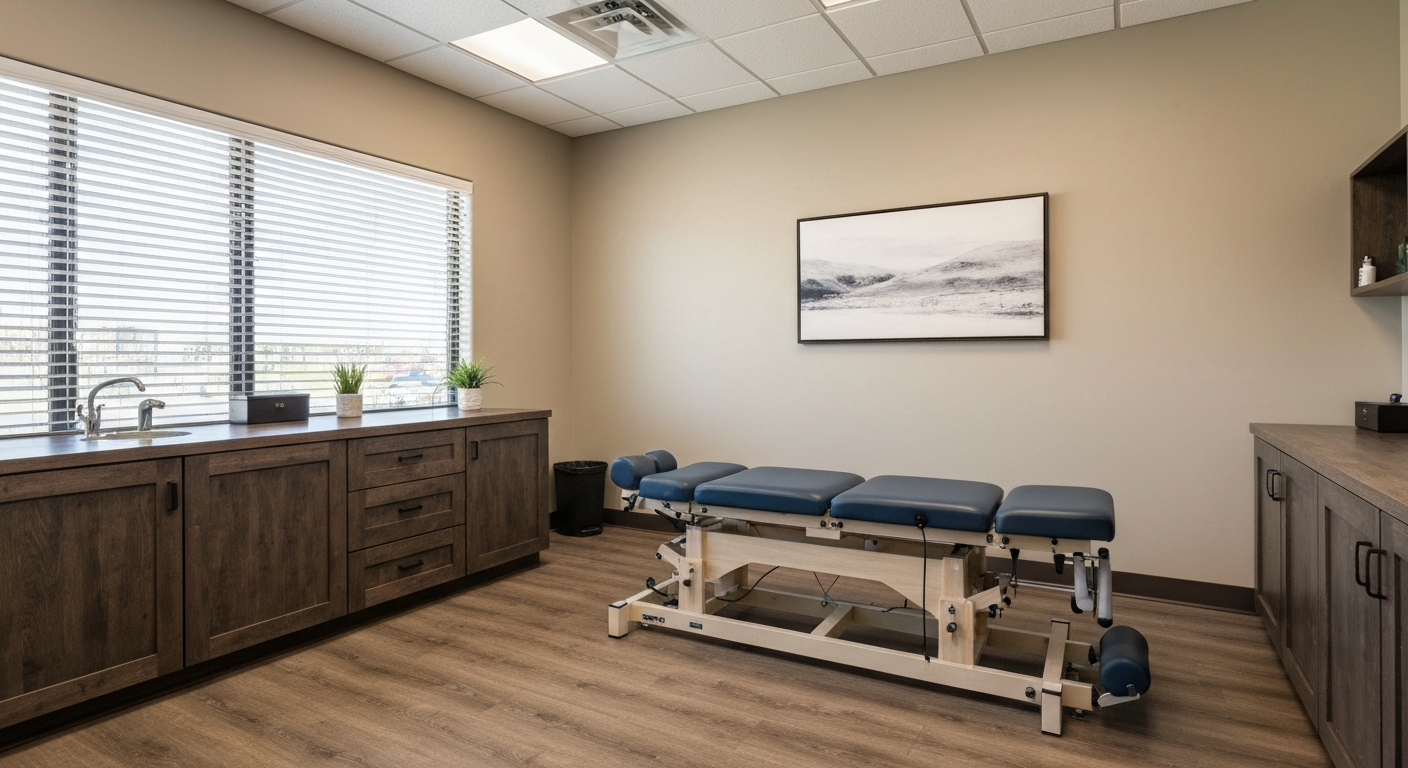
Mid-range ($25,000–$45,000): New or lightly used adjusting tables, a digital X-ray system (essential for most full-scope practices), physiotherapy equipment like ultrasound and electrical stimulation units, and proper software for EHR and billing.
Higher end ($45,000–$60,000): Multiple adjusting tables for a multi-room setup, full digital radiography suite, decompression table, cold laser or other specialty modalities. This is more of a built-out practice from day one than a lean startup.
One note on X-ray: Oklahoma requires specific compliance with radiation equipment registration. Contact the Oklahoma Department of Environmental Quality or your malpractice carrier for current requirements before purchasing any radiography equipment.
Used chiropractic equipment from reputable dealers or practice liquidations can cut these costs significantly. Equipment that sells for $8,000 new often goes for $2,500-$3,500 used and functions identically.
Build-Out and Leasehold Improvements: $15,000–$60,000
This varies more than almost anything else in the startup budget. It depends on your market, the condition of the space you lease, and how finished you need it to be on day one.
Oklahoma commercial real estate is genuinely cheap compared to coastal markets. Mid-size cities like Tulsa and Oklahoma City have medical office spaces running $12–$22 per square foot annually, compared to $40–$80+ in Los Angeles or Boston. That gap compounds quickly over a multi-year lease.
On the lower end ($15,000–$25,000): A space that’s already partially built out for a medical or professional use, requiring only minor modifications — a reception desk, signage, paint, basic HVAC adjustments, and a couple of treatment room partitions.
Mid-range ($25,000–$45,000): A vanilla office shell that needs treatment rooms framed out, a private consultation space, plumbing if you’re adding a restroom, and proper flooring and lighting. Most solo-practice buildouts land here.
Higher end ($45,000–$60,000): A larger footprint (1,500–2,500 sq ft), multiple treatment rooms, a dedicated X-ray room with appropriate shielding, waiting area built from scratch, and a billing/admin area.
Negotiate your build-out with the landlord. In Oklahoma’s current commercial market, landlords in secondary markets often offer tenant improvement (TI) allowances — cash or rent credits toward your build-out — to secure a long-term tenant. A 3-5 year lease in a secondary market might get you $10,000–$20,000 in TI allowance, which directly reduces your cash outlay.
Insurance: $2,000–$6,000/Year
The range here covers malpractice plus general liability. A solo practitioner with a clean record in Oklahoma typically lands somewhere in the $2,000–$4,000/year band for malpractice. Add general liability (which covers slip-and-fall and property damage claims from patients in your office) and you’re looking at another $500–$1,500/year depending on your space size and carrier.
If you bring on an associate chiropractor or chiropractic assistant, your premiums go up. Budget accordingly.
Total Startup Range: $40,000–$150,000
Here’s how that shakes out:
| Item | Low End | High End |
|---|---|---|
| LLC formation | $100 | $100 |
| Equipment | $15,000 | $60,000 |
| Build-out | $15,000 | $60,000 |
| Insurance (year one) | $2,000 | $6,000 |
| Signage, software, supplies | $3,000 | $8,000 |
| Working capital (3 months) | $5,000 | $16,000 |
| Total | ~$40,000 | ~$150,000 |
The low end is a lean, used-equipment, partially built-out solo practice in a smaller Oklahoma market. The high end is a fully outfitted multi-room practice in Oklahoma City or Tulsa with new equipment and a significant build-out. Most first practices land somewhere in the $60,000–$90,000 range.
For context: the same practice in Southern California would realistically run $120,000–$250,000. Oklahoma’s cost structure isn’t a marginal advantage — it’s a meaningful one.
Financing Options
Small Business Administration (SBA) loans are a common path for practice startup financing, particularly the SBA 7(a) loan. Healthcare practices have historically been viewed as relatively low-risk borrowers by SBA lenders because of predictable billing cycles and strong demand.
Oklahoma also has the Oklahoma Center for the Advancement of Science and Technology (OCAST) and the Oklahoma Department of Commerce with programs for small business development, though these are more relevant for tech or manufacturing than a chiropractic practice. Your best resource is likely the Oklahoma Small Business Development Center (SBDC) network — they offer free consulting and can help you put together financial projections and a loan package.
Quick Reference: Key Contacts
- Oklahoma Board of Chiropractic Examiners: osbce.ok.gov
- Oklahoma Secretary of State (LLC filing): sos.ok.gov | 421 NW 13th Street, Suite 210, Oklahoma City, OK 73103 | (405) 521-3912
- IRS EIN application: irs.gov/ein
- Oklahoma Tax Commission (OkTAP): oktap.tax.ok.gov
What to Do First
Get your OSBCE application submitted — or at minimum, confirm your eligibility — before spending serious time on business planning. Licensing timelines can stretch, and you don’t want to sign a lease and buy equipment while your license application is sitting in a queue.
Once you have a license (or a clear approval timeline), file the LLC, get your EIN, and start the space search. Oklahoma’s market is friendly enough that you don’t need to rush into a bad lease out of fear. Take the time to find the right space at the right terms.
The business side here isn’t complicated. The hard part is building a patient base. Everything else — the LLC, the license, the build-out — is just paperwork and checkbooks.