How to Start a Catering Business in Oklahoma
How to Start a Catering Business in Oklahoma
Oklahoma’s catering market is genuinely good right now. OKC and Tulsa are hosting more weddings, corporate events, and private parties than they were five years ago, and the demand for full-service catering — not just drop-off trays from a deli — is outpacing the supply of qualified caterers. That’s a real opening.
But catering in Oklahoma sits in a specific regulatory category that trips up a lot of first-timers. It’s not a restaurant, so you don’t need a storefront. It’s also not cottage food, so you can’t prep everything in your home kitchen and call it done. Catering is food service. That means commercial kitchens, OSDH licensing, food handler permits, and — if you’re serving drinks — an ABLE Commission license on top of everything else.
This guide covers the full stack, in order. Start here, follow the steps, and you’ll have a clear picture of what it actually costs and what it actually takes.
Why Start a Catering Business in Oklahoma?
The economics work in your favor compared to most states. Oklahoma’s lower cost of living keeps your ingredient and labor costs down relative to coastal markets, which means healthier margins on the same ticket prices. You’re not paying Austin or Denver prices for prep cooks.
Catering also carries far lower overhead than a restaurant. No front-of-house staff, no daily foot traffic to chase, no 7-days-a-week grind just to keep the lights on. Revenue is event-based — you book a Saturday wedding, you staff it, you get paid. That model is genuinely friendlier for someone who wants to launch while keeping a day job. Many successful Oklahoma caterers started with weekend events, built a client list over 18 months, and went full-time only after demand forced the issue.
Oklahoma also removed a couple of financial friction points that used to apply. The state franchise tax was repealed effective January 1, 2024 — that previously hit corporations, though LLCs were already exempt. And there’s no statewide general business license in Oklahoma. Business licensing is handled locally, and many cities don’t require one for a catering operation that doesn’t have a retail storefront. Less bureaucracy than you might expect.
Step 1: Choose Your Business Structure
File an LLC. This isn’t the place to operate as a sole proprietor.
Catering carries specific liability risks that make the LLC structure worth every penny of the $100 filing fee at sos.ok.gov. Foodborne illness at a catered event doesn’t affect one person — it affects everyone who ate the chicken at the rehearsal dinner. That’s a mass claim situation. Add allergic reactions, property damage at venues (a Sterno flame meets a tablecloth), and the potential for alcohol-related incidents if you’re serving drinks, and you have a liability profile that demands a legal barrier between the business and your personal assets.
File online at the Oklahoma Secretary of State’s website. The fee is $100. After that, you’ll pay a $25 Annual Certificate each year on the anniversary of your formation. That’s it for state-level business entity costs.
If you plan to offer alcohol service at events, talk to a business attorney about whether a separate LLC for that piece of the operation makes sense. Some caterers structure the food service and the bar service as distinct entities specifically because the liability profiles are so different. It adds complexity, but it also adds a firewall.
Step 2: Secure a Commercial Kitchen
This is the biggest hurdle, and there’s no way around it.
Catering operations are classified as food service establishments under Oklahoma law. That means you must prepare food in a licensed commercial kitchen. Your home kitchen — no matter how large, how well-equipped, or how recently renovated — does not qualify unless it has been inspected and licensed by the Oklahoma State Department of Health (OSDH).
Here’s the confusion point worth addressing directly: the Oklahoma Homemade Food Freedom Act (HB 1032, 2021) does NOT cover catering. That law lets individuals sell homemade food directly to consumers — baked goods at a farmers market, jams sold out of your house, that kind of thing. It exists for direct-to-consumer cottage food sales with a $75,000/year cap. The moment you’re preparing food in bulk to serve at an event for multiple guests, you’re operating as a food service establishment, and the cottage food exemption doesn’t apply.
You have three realistic options for getting into a compliant kitchen.
Option 1: Rent space in a shared commissary kitchen. This is the right starting point for most new caterers. Shared commercial kitchens in OKC and Tulsa typically run $500–$1,500/month for regular access, or $15–$40/hour if you only need occasional time. You get access to commercial-grade equipment, a licensed facility, and no build-out costs. Many commissary kitchens cater specifically to caterers and food entrepreneurs and understand your workflow.
Option 2: Build out your own commercial kitchen. Expect to spend $30,000–$100,000 or more, depending on size, equipment, and whether you’re building from scratch or renovating an existing space. This makes sense eventually — once you’re booking enough events to justify the capital expenditure — but it’s a significant bet for a startup.
Option 3: Partner with a restaurant that has off-peak kitchen capacity. Some restaurants are open for dinner only and have idle kitchen space during mornings and afternoons. A formal agreement to use their licensed kitchen during those hours can work well, and the arrangement is mutually beneficial. Just make sure the agreement is in writing and that the restaurant’s OSDH license covers your use of the space.
Regardless of which path you take, the kitchen must pass OSDH inspection.
Step 3: Get Your OSDH Food Establishment License
Contact the Oklahoma State Department of Health to get this process started.
If you’re building or renovating your own commercial kitchen, you’ll need a plan review before you open. Submit your plans to the local county health department. The plan review fee is $425. This review checks your layout, equipment, ventilation, and sanitation systems before you invest in a full build-out — worth doing right so you don’t fail an inspection after spending $80,000.
The OSDH Food Establishment License itself costs $425 for a new establishment and $335 per year for renewal (late renewal is $375, so don’t miss the anniversary date).
If you’re using a shared commissary kitchen, that kitchen should already hold its own OSDH license. But you still need your own food establishment license as the business operating from that kitchen. You and the commissary kitchen are two separate licensed entities. This surprises some people — but think of it this way: the kitchen is licensed, and your catering operation is licensed. Both need to be in order.
Food handler permits are required for every staff member who prepares or serves food, obtained within 30 days of hire. Oklahoma caps the cost at $15 per permit. This applies to everyone — your prep cook, your servers, your on-site chef.
Beyond the basic permit, at least one person on your team — ideally you — should hold a Food Protection Manager Certification. ServSafe is the most widely recognized program. This is the difference between understanding the rules and actually knowing why they exist.
Temperature control deserves special attention in catering. You’re not serving food immediately out of a kitchen — you’re transporting it, holding it for hours, and serving it in venues without commercial equipment. Oklahoma requires hot-holding at 135°F or above and cold-holding at 41°F or below. That means chafing dishes, hot boxes, insulated cold containers, and a food thermometer you actually use. Foodborne illness claims almost always trace back to temperature abuse during transport or service.
Step 4: Alcohol Service (ABLE Commission)
A lot of caterers discover this layer only after booking a wedding where the client assumes bar service is included. Get ahead of it.
If you plan to serve alcohol at catered events, you need a license from the ABLE Commission — Oklahoma’s Alcoholic Beverage Laws Enforcement Commission. Contact the ABLE Commission directly to confirm the current caterer license category and applicable fees, as the specific license type for catering operations can vary based on your service model.
For reference, a mixed beverage license (full bar service: beer, wine, and spirits) costs $1,030 initially and $905 per year at renewal. If you’re serving beer and wine only, the initial cost is $525 with a $450 annual renewal. These are state-level fees; local fees may also apply depending on your operating jurisdiction.
Every staff member who serves alcohol must complete ABLE Commission-approved server training. This isn’t optional and it isn’t just a formality — it has direct bearing on your liability exposure.
Oklahoma operates under dram shop liability law (Title 37A). If a staff member serves a visibly intoxicated person who then injures someone, your business can be held liable. The legal standard is “visibly intoxicated” — not just drunk, but visibly, obviously impaired at the point of service. Liquor liability insurance is non-negotiable if you’re serving alcohol. More on that in the insurance section.
One important operational note: many venues already hold their own liquor license and handle alcohol service through their own staff. In those situations, you don’t need an ABLE license for that event — but confirm this in writing with every client. The question of who is responsible for alcohol service should be resolved before the contract is signed, not during the event.
Step 5: Register for State Taxes
Register at OkTAP (oktap.tax.ok.gov) for a Sales Tax Permit. The fee is $20 plus a handling fee. Do this before your first event.
Catering services in Oklahoma are subject to state sales tax. Oklahoma uses destination-based sales tax collection, which means you charge the tax rate applicable at the event location — not your kitchen address. The state base rate is 4.5%, but total rates (state + county + city) typically run 7–11% depending on where the event is held. An event in Tulsa will have a different combined rate than one in Edmond or Broken Arrow.
The practical implication: your effective sales tax rate changes with every event. Keep a record of each event location and look up the applicable rate. The Oklahoma Tax Commission website has a lookup tool. This isn’t complicated, but it does require discipline in your record-keeping.
If you’re hiring employees, workers’ compensation insurance is mandatory for all of them. Oklahoma has no minimum employee threshold for this requirement — one employee triggers the obligation. CompSource Mutual is the state-affiliated carrier, but you can use any private carrier approved to write workers’ comp in Oklahoma.
Step 6: Insurance
Your LLC protects your personal assets. Insurance protects the LLC. You need both.
General liability insurance runs $1,000–$3,000 per year for a catering operation and covers property damage at venues (broken equipment, stained linens, damaged furniture) and slip-and-fall injuries at your events. This is table stakes — most venues will require it.
Product liability covers foodborne illness claims and allergic reaction incidents. It’s usually bundled with general liability rather than sold separately. Make sure your policy specifically includes food product liability and that the coverage limits are adequate. A single foodborne illness event affecting 50 guests can generate claims that exceed $100,000.
Liquor liability runs $500–$2,000 per year and covers alcohol-related incidents if you’re serving drinks. If you have an ABLE license, you need this policy. Period. It’s not expensive relative to the exposure.
Commercial auto insurance covers your vehicle when you’re transporting food to events. Your personal auto policy will not cover you if you’re using the vehicle for business purposes and have an accident — make sure your commercial policy is in place before you load the first chafing dish.
Workers’ comp is legally required for any employees, as covered above.
One detail that catches new caterers off guard: many venues require a certificate of insurance that names the venue as an additional insured for the event. This is standard practice and your insurer can issue these per-event certificates. But know that it requires a quick turnaround — confirm with your insurer how much lead time they need and build that into your booking process. The venue may ask for the certificate 30 days out.
Startup Costs at a Glance
The range is wide depending on whether you rent kitchen space or build your own. Here’s an honest breakdown.
Starting with a shared commissary kitchen: $8,000–$25,000 This covers your first months of kitchen rent, essential equipment and smallwares, insurance, licensing fees, and initial food inventory. It’s a real business at a fraction of the capital required for a restaurant.
Building your own commercial kitchen: $50,000–$150,000+ Build-out, equipment, and licensing. Not a starting-from-scratch move for most people.
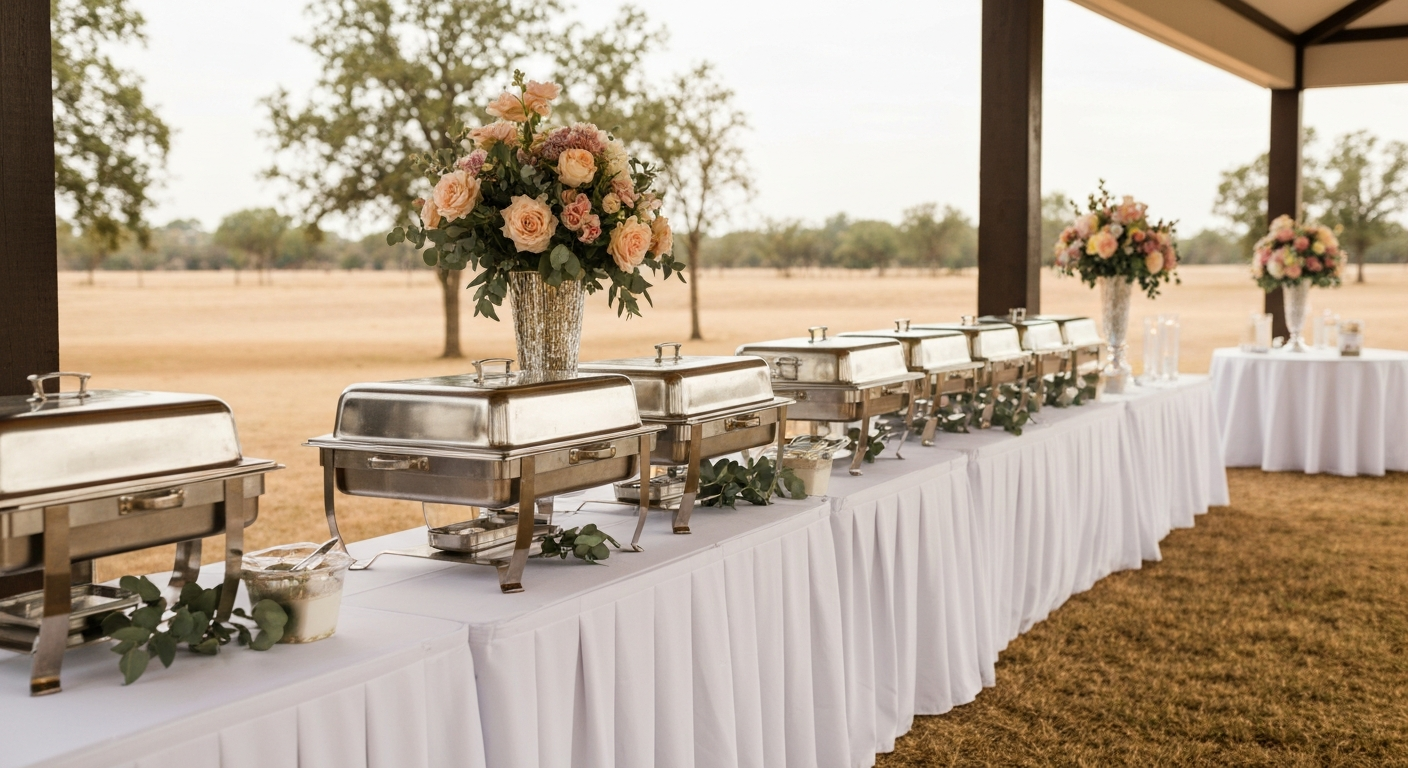
Catering equipment specifics: Chafing dishes run $200–$800 depending on quantity and quality. Hot and cold transport containers (Cambros, insulated carriers) run $300–$1,000 to get properly equipped. Serving ware — plates, platters, utensils, serving spoons — adds another $500–$2,000. Portable cooking equipment (induction burners, propane burners, griddles) runs $500–$3,000. Buy commercial-grade from the start. Consumer equipment fails under the volume and heat of catering work.
Licensing and registration fees:
- OSDH license + plan review (own kitchen): $850 first year
- OSDH license only (using already-licensed shared kitchen): $425 first year
- ABLE Commission (beer and wine): $525 first year; (full bar): $1,030 first year
- LLC filing: $100 + $25/year Annual Certificate
- Sales Tax Permit: $20
Insurance: $2,000–$5,000/year for a basic package (general/product liability, commercial auto, workers’ comp if you have employees). Add $500–$2,000 for liquor liability if you’re serving alcohol.
Vehicle: If you already own a suitable vehicle, start there with insulated transport containers. A refrigerated van — which gives you real capacity and temperature control — runs $15,000–$40,000 used. It’s not a day-one purchase for most caterers, but it’s a natural second-year investment as volume grows.
Before You Book Your First Event
Get the commercial kitchen situation resolved first. Everything else — the license, the food handler permits, the insurance — follows from having a licensed kitchen. Without it, you’re not legally operating as a caterer.
Register your LLC, secure your kitchen, apply for the OSDH license, get your team’s food handler permits in order, and register for sales tax. That’s the core stack. Add the ABLE Commission license if alcohol is part of your service offering — and be honest with yourself about whether clients will expect it, because most wedding and corporate clients will.
Oklahoma’s event market is growing. The regulatory cost is real but manageable. Get the structure right from the start and you won’t be retrofitting compliance into a business that’s already operating — which is a much harder problem to solve.