How to Start a Barbershop Business in Oklahoma
How to Start a Barbershop Business in Oklahoma
Oklahoma is genuinely one of the better states to open a barbershop right now. No franchise tax (repealed January 1, 2024), a $25/year LLC annual fee, and commercial lease rates in most Oklahoma cities that would make a Denver shop owner cry. The licensing process runs through one agency — the Oklahoma State Board of Cosmetology and Barbering — and while there are real requirements, none of them are designed to bankrupt you before you open.
Here’s what you actually need to do.
OSBCB Establishment License
Every barbershop operating in Oklahoma needs an establishment license from the Oklahoma State Board of Cosmetology and Barbering (OSBCB). This is separate from your individual barber license. The shop itself needs to be licensed.
The initial establishment license costs $120. Renewal runs $90. You can reach OSBCB directly at [email protected].
Before you get that license, an OSBCB inspector will review your space. Oklahoma law requires that establishments be inspected at least twice per year after opening — so this is an ongoing relationship, not a one-time hurdle. Inspections cover sanitation practices, equipment condition, proper disposal procedures, and whether your physical setup meets state standards for a barbershop. Pass the first inspection and you’re open. Keep your shop clean and properly equipped and the follow-up inspections are routine.
One hard rule: every barber working in your shop must hold a valid OSBCB barber license. Not a cosmetology license. Not an out-of-state license (without proper reciprocity). A current Oklahoma barber license. This applies whether they’re an employee, a booth renter, or a part-time fill-in. If someone behind a chair in your shop doesn’t have a valid license, that’s your liability as the establishment owner. OSBCB takes this seriously. Build a system for verifying and tracking license status for every person cutting hair under your roof — before day one.
Barber License Requirements in Oklahoma
If you’re planning to cut hair yourself — not just own the business — you need your own OSBCB barber license. And if you’re hiring barbers, understanding what that license requires helps you know who you can actually hire.
Step 1: Complete an OSBCB-approved barber program.
Oklahoma requires barber candidates to complete a state-approved barber education program. These programs cover hair cutting, shaving, scalp treatments, sanitation, and the science behind what barbers do. Program length and specific curricula are set by OSBCB. Not every cosmetology or trade school offers the barber track specifically — confirm the program is OSBCB-approved before enrolling.
Step 2: Pass both the written and practical exams.
After completing your program, you’ll take a written exam and a practical (hands-on) exam. Both are required. The written test covers theory, sanitation, safety, and Oklahoma-specific rules. The practical exam tests actual barbering skills on a model. Neither is optional — you need both to get licensed.
Step 3: Age and education requirements.
Minimum age and education requirements apply to barber applicants in Oklahoma. OSBCB sets these thresholds, and they exist for good reason — you’re working with sharp instruments on paying clients. Check directly with OSBCB at oklahoma.gov/cosmo for current requirements, as these can be updated.
If you’re hiring experienced barbers from another state, look into Oklahoma’s reciprocity process. Out-of-state licensees may qualify for an Oklahoma license without repeating all requirements, depending on their home state’s standards. Still goes through OSBCB. Still requires documentation. But it can speed up your hiring timeline considerably if you’re recruiting talent.
Business Structure and Costs
The shop license gets you compliant with OSBCB. The business structure handles everything else — liability protection, taxes, and your legal existence as a company.
Form an LLC: $100 + $25/Year
For most solo or small barbershop owners, an LLC is the move. It separates your personal assets from business liabilities, which matters a lot when you’re running a business that involves blades, chemicals, and the public.
Oklahoma LLC formation costs $100, filed online at sos.ok.gov. The annual certificate — the filing that keeps your LLC in good standing — is $25/year, due on your anniversary date. That’s it. Oklahoma eliminated its franchise tax effective January 1, 2024, so there’s no longer a minimum annual tax just for existing as a business entity. Compare that to California’s $800/year minimum franchise tax and you start to appreciate the Oklahoma cost structure.
You’ll also need an EIN (Employer Identification Number) from the IRS. Free at irs.gov/ein. Takes about 10 minutes. You need this for your business bank account, tax filings, and to hire employees.
City Business License
Oklahoma has no statewide general business license — that decision is made at the city level. Tulsa, Oklahoma City, Edmond, Norman, Broken Arrow — they each have their own requirements and fees. Some cities require a general business license. Some have specific requirements for personal service businesses. Check with your city’s business licensing office before you open. This is usually a small fee and a straightforward application, but skipping it creates unnecessary exposure.
Workers’ Comp: The Compliance Detail That Catches People Off Guard
Oklahoma requires workers’ compensation insurance for all employers — no minimum employee threshold. If you hire one barber, you need workers’ comp. If you have a part-time shampoo assistant, you need workers’ comp. This isn’t optional and it doesn’t kick in at five employees or ten employees. One employee = mandatory coverage.
You can get coverage through CompSource Mutual or through a private insurance carrier. Your general business insurance broker can typically handle this alongside your general liability policy.
This is the compliance detail most new barbershop owners miss. They budget for the establishment license, the LLC fee, and the build-out — and then get surprised by workers’ comp costs and requirements once they start hiring. Plan for it from the beginning.
Oklahoma Tax Registration
If you’re selling retail products — pomades, styling products, beard oil — you need a Sales Tax Permit from the Oklahoma Tax Commission. Register through OkTAP. The permit costs $20 plus a handling fee. Oklahoma’s base state sales tax is 4.5%, but local rates bring the total to somewhere between 7% and 11% depending on where your shop is located. Barbering services themselves have their own sales tax treatment — check with the OTC or a local accountant on how that applies to your specific service menu.
Startup Costs at a Glance
Oklahoma’s cost structure is genuinely favorable for barbershop startups. Here’s what a realistic budget looks like:
| Item | Estimated Cost |
|---|---|
| LLC formation | $100 (one-time) |
| LLC annual certificate | $25/year |
| OSBCB establishment license | $120 (initial) |
| Barber chairs | $3,000–$12,000 |
| Build-out / leasehold improvements | $15,000–$40,000 |
| General liability + workers’ comp insurance | $1,000–$3,000/year |
| Total lean startup range | $20,000–$45,000 |
A few notes on those numbers:
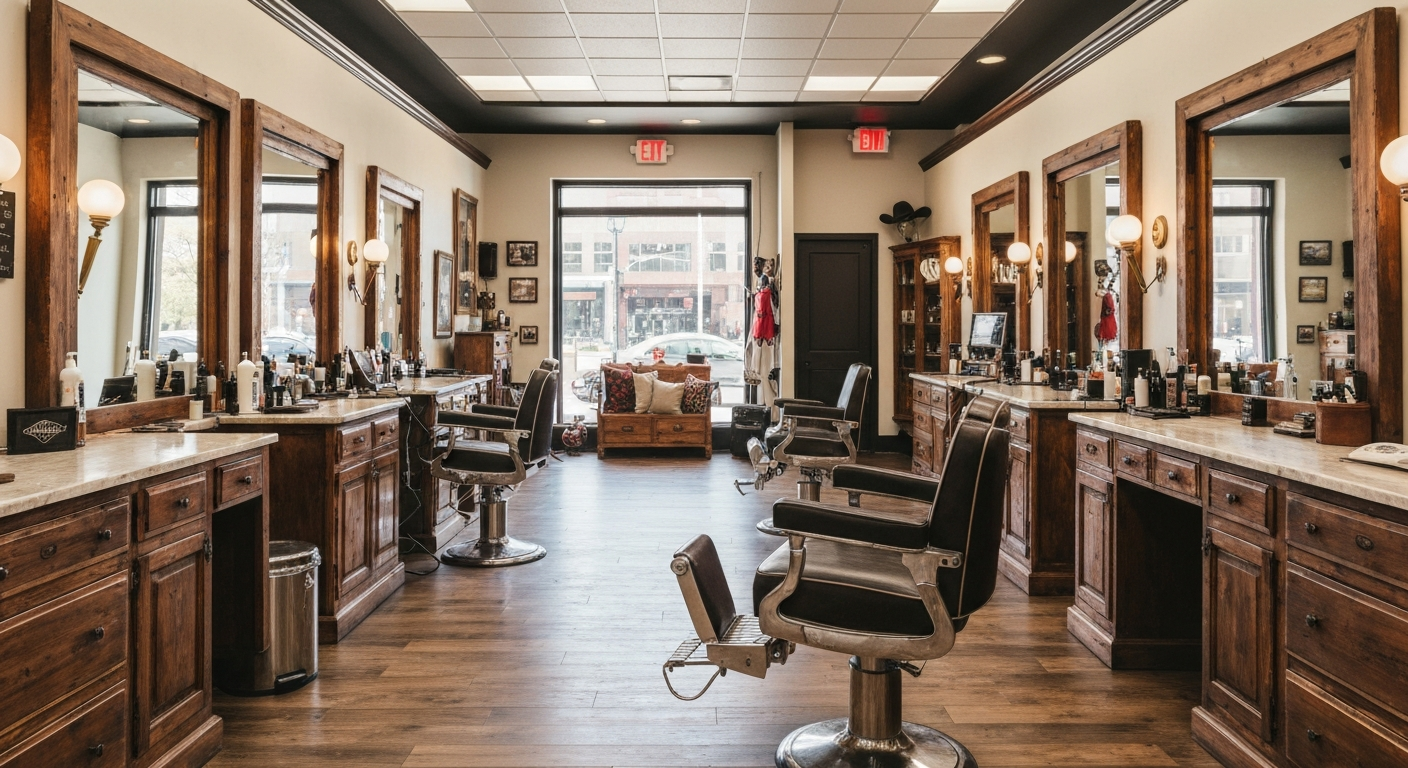
Barber chairs are where you can either spend strategically or blow your budget. A solid entry-level hydraulic barber chair runs $300–$600. A mid-range commercial chair with a proper footrest, reclining back, and the durability to handle daily use for a decade runs $800–$1,500. The high end — vintage-style chairs, Koken restorations, imported Italian equipment — can hit $3,000+ per chair. For a three-chair shop, plan accordingly. Buy quality over aesthetics on your first shop. Chairs that break down hurt your revenue and your reputation.
Build-out costs vary enormously based on your space’s condition. A raw commercial space requires more work than a former salon or barbershop location. If you can find a space with existing plumbing, proper ventilation, and a layout that works for barbering, you can cut build-out costs significantly. Barbershops generally have lower build-out costs than full-service salons — you don’t need shampoo bowl plumbing at every station, chemical storage infrastructure, or the ventilation requirements for color services. That’s a real cost advantage. A lean three-chair barbershop in a suitable space can come in around $15,000–$20,000 for build-out. A full renovation of a raw space with custom cabinetry and new plumbing can push $40,000 or beyond.
Insurance at $1,000–$3,000/year covers general liability and workers’ comp. Get quotes from multiple carriers. Your premium will depend on your number of employees, your revenue projections, your claims history, and your location. Don’t cheap out here — general liability protects you when a client claims an injury, a reaction, or property damage. Workers’ comp protects you when an employee is hurt on the job. Both are real risks in a barbershop environment.
The total lean startup range of $20,000–$45,000 assumes you’re not buying a full buildout from scratch, you’re getting 2-3 quality chairs at mid-range prices, and you’re keeping equipment costs disciplined. It does not include your first few months of rent, your initial supply inventory, signage, point-of-sale systems, or working capital. Budget those separately. A realistic total opening budget — including soft costs and two to three months of runway — is typically $35,000–$75,000 depending on your market and buildout situation.
The Order of Operations
Don’t try to do everything simultaneously. Here’s a logical sequence:
- Form your LLC at sos.ok.gov ($100). Get your EIN from the IRS (free).
- Secure your location. Sign a lease only after confirming the space is zoned for personal service businesses. Check with your city’s planning department.
- Register with the Oklahoma Tax Commission via OkTAP if you’ll sell any retail products.
- Apply for your city business license (requirements vary — check with your city).
- Build out your space to meet OSBCB establishment standards.
- Apply for your OSBCB establishment license at oklahoma.gov/cosmo. Schedule your inspection.
- Verify barber licenses for every person who will work in your shop before they start.
- Get workers’ comp coverage before your first employee starts. Not after.
The OSBCB establishment license application and the physical inspection are your real critical path items. OSBCB can tell you exactly what they’re looking for in an inspection — contact them at [email protected] before your build-out is finalized so you’re not retrofitting anything.
What Makes Oklahoma Work for This Business
The economics here are straightforward. A three-chair barbershop in Tulsa or Oklahoma City at $2,500–$4,000/month in rent, with experienced barbers generating $1,500–$2,500/week each in revenue, produces solid margins at a price point ($25–$45/cut) that clients in this market actually pay without hesitation.
No franchise tax. A $25/year entity maintenance cost. Lower commercial rents than coastal metros. A genuine demand for quality barbershops in growing suburban areas across the state.
The compliance costs are real but manageable — $120 for your establishment license, individual barber licensing for your staff, workers’ comp from day one, and twice-yearly inspections that keep you honest about your shop’s condition. None of those are bad things. They’re the baseline for running a legitimate, professional business.
Your next step is the OSBCB website at oklahoma.gov/cosmo. Download the establishment license application, read the inspection checklist, and call them at the number listed if you have questions about your specific space or situation. They’re approachable. Use that resource before you sign a lease.