How to Start a Business in Sand Springs, Oklahoma
Why Start a Business in Sand Springs?
Sand Springs was literally built as a model community. In 1911, philanthropist Charles Page founded the city to support orphans and widows — the Sand Springs Children’s Home and Charles Page Family Village still operate today, more than a century later. That founding story isn’t just history. The DNA of a city designed to support its residents shows up in Sand Springs’ practical, working-class identity and in how the community relates to local businesses.
The city’s population sits at approximately 20,330 (2024), with modest growth around 0.5% annually. Sand Springs is a western suburb of Tulsa, roughly 10 miles from downtown Tulsa via I-44 and Highway 97. It’s close enough to tap the Tulsa metro economy — your employees can commute from Tulsa, and your customers can drive in — but far enough to maintain its own identity and, more importantly, its own cost structure.
That cost structure is the first thing to understand if you’re evaluating Sand Springs as a business location. The cost of living index is 86.4, where the national average equals 100. Housing costs are below national norms. Commercial rent is well below what you’d pay in south Tulsa suburbs like Bixby or Jenks. Wages for equivalent positions are lower because the entire cost baseline is lower. If you’re comparing operating costs across the Tulsa metro, Sand Springs offers meaningfully cheaper overhead.
The median household income is approximately $73,400 (2023). That’s lower than the affluent eastern Tulsa suburbs — Bixby’s median is $104,000, and Jenks is comparable — but it’s solid middle-class income for a city with Sand Springs’ cost profile. The population can support retail and service businesses, and the manufacturing and healthcare sectors provide stable employment that keeps money circulating locally.
Sand Springs spans three counties: Tulsa, Osage, and Creek. Most of the city’s population is in the Tulsa County portion, but this three-county geography has practical implications for your sales tax calculations that you’ll need to address before opening.
Step 1: Choose Your Business Structure
An LLC costs $100 to file with the Oklahoma Secretary of State at sos.ok.gov, plus $25/year for your Annual Certificate due on your formation anniversary. That $25 annual payment is your total ongoing state obligation for maintaining an LLC. Oklahoma repealed its franchise tax effective January 1, 2024, so there’s no additional annual entity tax for any business type.
A corporation costs $50 to file with the same $25/year Annual Certificate. For manufacturing or industrial businesses — which are common in Sand Springs given the city’s economic base — a corporation may be appropriate if you plan to issue stock, attract institutional investors, or eventually take the company public. For most small and mid-size operations, an LLC provides the same liability protection with less administrative overhead.
For manufacturing and industrial businesses specifically, entity formation isn’t optional — it’s essential. A sole proprietorship requires no state filing, but it offers zero liability protection. In industries where workplace injuries, equipment failures, product defects, or environmental incidents can generate significant claims, operating without a liability shield puts your personal assets — your home, your savings, your other investments — directly at risk. The $100 LLC filing fee is the cheapest insurance you’ll ever buy.
You can reserve a business name with the Secretary of State for $10 if you need time before filing your full formation documents. The Oklahoma Secretary of State is located at 421 NW 13th Street, Suite 210, Oklahoma City, OK 73103, phone (405) 521-3912, but online filing at sos.ok.gov handles most transactions.
Step 2: State Tax Registration
Register for your Oklahoma Sales Tax Permit through OkTAP (Oklahoma Taxpayer Access Point) at oktap.tax.ok.gov. The permit costs $20 plus a handling fee. It’s required for any business selling taxable goods or services in Oklahoma, and it’s the document that Sand Springs will ask for when you apply for your city business license.
Sand Springs’ manufacturing base means many local businesses are B2B — selling components, raw materials, services, or supplies to other businesses rather than directly to consumers. If most of your sales are wholesale, you still need the Sales Tax Permit. Here’s why: the wholesale exemption is claimed by the buyer, not by you as the seller. Your customer presents you with a sales tax exemption certificate, and you keep it on file. But you — the seller — need the Sales Tax Permit to participate in the system at all. Without it, you can’t legally sell, even to other businesses.
Oklahoma’s base state sales tax rate is 4.5%. On top of that, you collect city and county taxes. The combined rate varies by location (more on Sand Springs’ specific rates below). You file and remit all collected sales tax through OkTAP on a schedule assigned by the Oklahoma Tax Commission — monthly, quarterly, or semi-annually based on your volume.
If you’re hiring employees, register for employer withholding tax through OkTAP at the same time as your Sales Tax Permit. And workers’ compensation insurance is mandatory for all employers in Oklahoma with no minimum employee count. There’s no five-employee threshold, no small-business exemption. Your first hire triggers the requirement. Get coverage through CompSource Mutual or a private carrier before your first employee’s start date. In manufacturing and industrial settings, where workplace injury risk is higher than average, workers’ comp isn’t just legally required — it’s operationally critical.
Get your EIN (Employer Identification Number) from the IRS before starting the OkTAP registration — you’ll need it. The EIN is free and available instantly at irs.gov/ein.
Step 3: City Business License
Sand Springs requires a local business license for businesses operating within city limits. The licensing process is managed through the City Clerk and Community Development departments at City Hall.
City of Sand Springs: sandspringsok.org City Hall: 100 E. Broadway St, Sand Springs, OK 74063 Phone: (918) 246-2500
Contact the City Clerk or Community Development department for specific license requirements for your business type. Bring your Oklahoma Sales Tax Permit — it’s required documentation for the city license application. The city staff handles licensing, zoning, and building permits, so you can often address multiple items during a single visit.
Sand Springs’ licensing process is relatively straightforward for standard business types. The city is accustomed to working with a range of businesses — from traditional retail and food service to manufacturing and industrial operations that are part of the city’s economic core. The Community Development staff can walk you through the specific requirements for your situation.
If you’re opening a manufacturing or industrial business, expect additional conversations about environmental compliance, building code requirements for industrial use, and potentially fire department inspections depending on your operations. These aren’t obstacles — they’re standard for industrial businesses anywhere in Oklahoma — but they add steps beyond what a retail shop or professional office requires.
Sales Tax Breakdown
Sand Springs’ city sales tax rate is 4.05%. Combined with state and county taxes in the Tulsa County portion of the city, the total rate comes to approximately 8.92%: state 4.5% + Tulsa County 0.367% + city 4.05%, per Avalara 2026 data.
Here’s the wrinkle that makes Sand Springs unusual: the city spans three counties — Tulsa, Osage, and Creek. The city tax rate stays the same at 4.05% regardless of which county your business is in, and the state rate is always 4.5%. But the county rate differs depending on your address. The Tulsa County rate of 0.367% doesn’t necessarily apply if your business is in the Osage or Creek County portions of Sand Springs.
Before you set up your point-of-sale system, program your invoicing software, or file your first sales tax return, verify the exact combined rate for your specific street address. You can look this up through OkTAP’s address-based rate tool or through Avalara’s free rate lookup. Getting the rate wrong — even by a fraction of a percent — means you’re either overcharging your customers (which creates refund obligations) or undercharging them and paying the difference out of your own revenue.
Oklahoma uses destination-based sales tax collection. For in-person sales at your Sand Springs location, you charge your location’s combined rate. But if you’re delivering products, selling online, or providing services at customer locations in other cities, you charge the rate at the customer’s delivery address. A Sand Springs manufacturer shipping products to a customer in Tulsa charges the Tulsa rate, not the Sand Springs rate. Your accounting system needs to handle this, especially if you’re doing business across multiple jurisdictions — which is common for B2B manufacturers and service providers.
The Manufacturing and Industrial Angle
Sand Springs has a manufacturing tradition that stretches back decades. The city’s workforce is experienced in production, logistics, skilled trades, welding, machining, and industrial maintenance. This isn’t a city where you need to train workers from scratch on manufacturing fundamentals — the talent pool already has the skills.
Industrial-zoned land is available along the Highway 97 corridor and near the Arkansas River. Compared to Tulsa proper, industrial real estate in Sand Springs comes at a lower price per square foot with more flexibility in lot sizes and building configurations. If you need a 10,000-square-foot production facility with loading docks and yard space, Sand Springs can deliver that at a price point that makes Tulsa or the south suburbs look expensive.
Sand Springs sits at a useful logistical crossroads within the regional economy. To the east, Tulsa’s transportation and logistics infrastructure — including the Port of Catoosa, one of the nation’s most inland river ports — provides shipping access to the Mississippi River system and beyond. To the north, oil refineries, processing facilities, and energy-sector operations in Osage County create demand for industrial services and supply chain support. If your business involves physical goods, raw materials, or industrial supply chain services, Sand Springs’ location between these two economic zones offers routing and proximity advantages.
The workforce angle deserves equal weight in your evaluation. Sand Springs’ blue-collar heritage means you can hire experienced production workers, machinists, welders, forklift operators, and logistics professionals without competing against the tech-sector and professional-services salaries that drive up labor costs in south Tulsa suburbs. A CNC operator or production supervisor in Sand Springs expects compensation calibrated to Sand Springs’ cost of living — not to Bixby’s $104,000 median household income. That wage differential, applied across a manufacturing payroll, represents significant savings.
The trade-off is market size. Sand Springs’ population of 20,330 isn’t large enough to support a high-volume consumer retail business on its own. But if your business model is B2B (selling to other businesses), manufacturing-oriented, or serving the broader Tulsa metro from a low-cost base, the smaller local population doesn’t matter — you’re not depending on walk-in traffic from Sand Springs residents.
Location and Zoning
Sand Springs’ commercial and industrial development is concentrated in several areas:
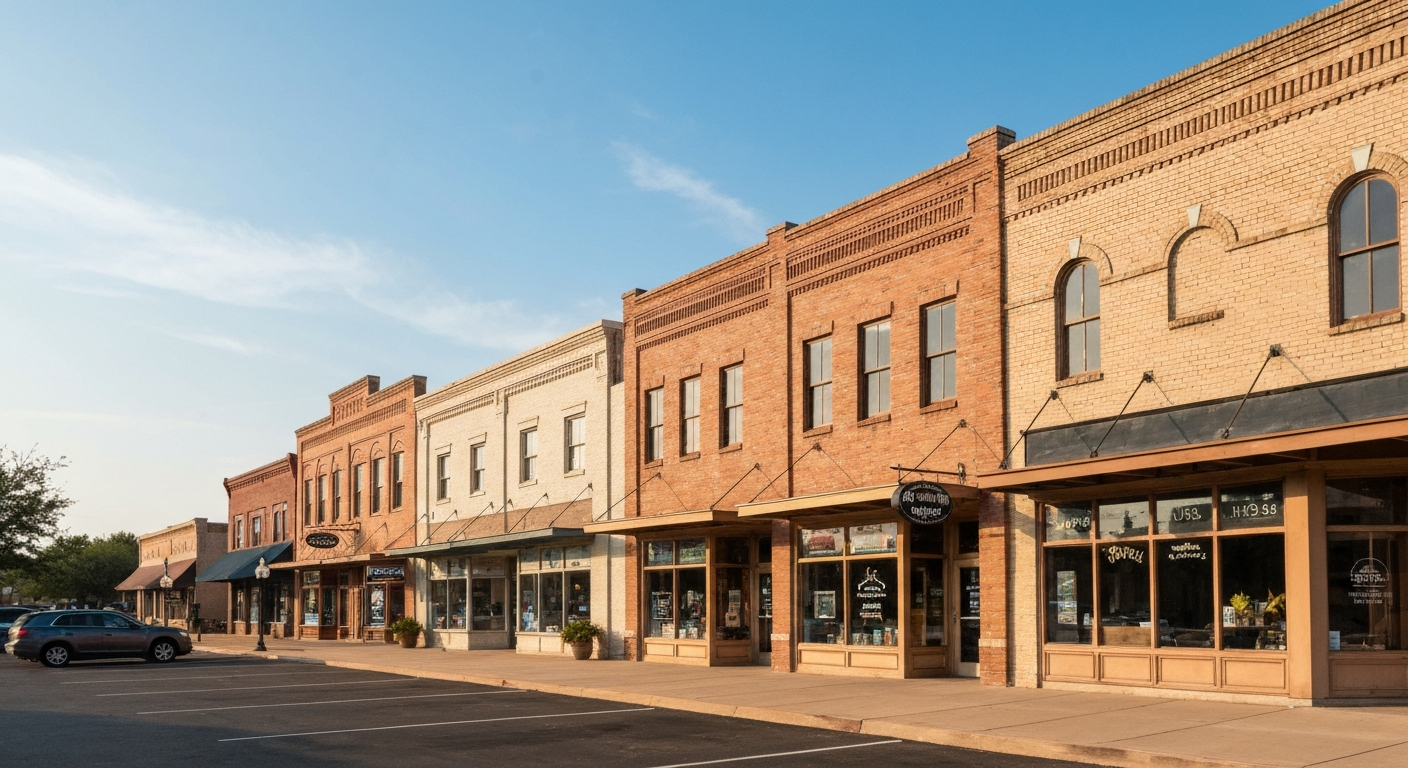
Broadway Street (downtown) is the civic core of Sand Springs, home to City Hall and traditional commercial activity. Suitable for retail shops, professional offices, restaurants, and community-facing businesses that serve the local population.
Highway 97 corridor runs north-south through the city and serves as the primary auto-oriented commercial strip. Restaurants, auto services, gas stations, and larger retail formats do well along this stretch. Highway 97 also connects to the industrial zones further north, making it a natural corridor for businesses that serve both consumer and industrial customers.
Near the Arkansas River you’ll find the industrial and manufacturing zones that define Sand Springs’ economic identity. Warehousing, distribution, fabrication, and production facilities are concentrated in this area, with access to transportation routes and proximity to raw materials.
For home-based businesses, contact Community Development about home occupation permits. Residential zones restrict commercial activity, and zoning clearance is required before the city will issue a business license for a home-based operation.
Contact the Planning Division before signing any commercial or industrial lease. Zoning verification ensures your proposed location is approved for your business type. In Sand Springs, this is especially important because the city has a mix of commercial, industrial, and residential zones in relatively close proximity — a space that looks commercial might be in a transitional zone with restrictions.
Costs at a Glance
Government fees for a basic LLC in Sand Springs:
- LLC filing: $100 (one-time) + $25/year Annual Certificate
- Sales Tax Permit: $20 (one-time)
- City business license: Varies by type
- EIN from IRS: Free
- Workers’ comp (if hiring): Varies by industry classification and payroll
- Name reservation (optional): $10
What you won’t pay: no franchise tax (repealed 2024), no city income tax, no state E-Verify mandate.
Total first-year government fees: approximately $150 to $200.
The bigger cost picture in Sand Springs works strongly in your favor. Commercial and industrial rent is significantly lower than Tulsa or the south Tulsa suburbs. The cost of living index of 86.4 means your wage costs for equivalent talent are lower across the board. Utilities for industrial operations are competitive. If your business model involves physical space, inventory, production equipment, or a blue-collar workforce, the savings in Sand Springs compared to Bixby, Jenks, or Tulsa proper add up to thousands — potentially tens of thousands — per year in reduced overhead.
The trade-off is clear: Sand Springs isn’t a destination economy like Jenks, and it doesn’t have Bixby’s affluent consumer spending power. Your business model needs to fit one of three patterns to work well here: serve Sand Springs’ 20,000 residents with everyday goods and services, serve the broader Tulsa metro from a lower-cost operating base, or plug into the city’s manufacturing and industrial supply chain. Each model works — but choose one intentionally rather than assuming the local market alone will sustain a premium-priced consumer business.