How to Start a Business in Jenks, Oklahoma
Why Start a Business in Jenks?
Jenks has the lowest city sales tax rate of any major Tulsa suburb at 3.55%. For a retail business doing $500,000 in annual sales, that half-point difference below neighboring cities saves your customers roughly $2,500 per year in sales tax compared to shopping in Bixby, Owasso, or Sand Springs. In a price-sensitive retail or restaurant market, that’s a genuine competitive edge that shows up in your customers’ receipts.
The city’s population stands at approximately 27,869 (2024), representing one of the most dramatic growth stories in Oklahoma — population has increased 191% since 2000. Median household income is approximately $104,970, placing Jenks among the highest-income communities in the Tulsa metro and in the same tier as neighboring Bixby.
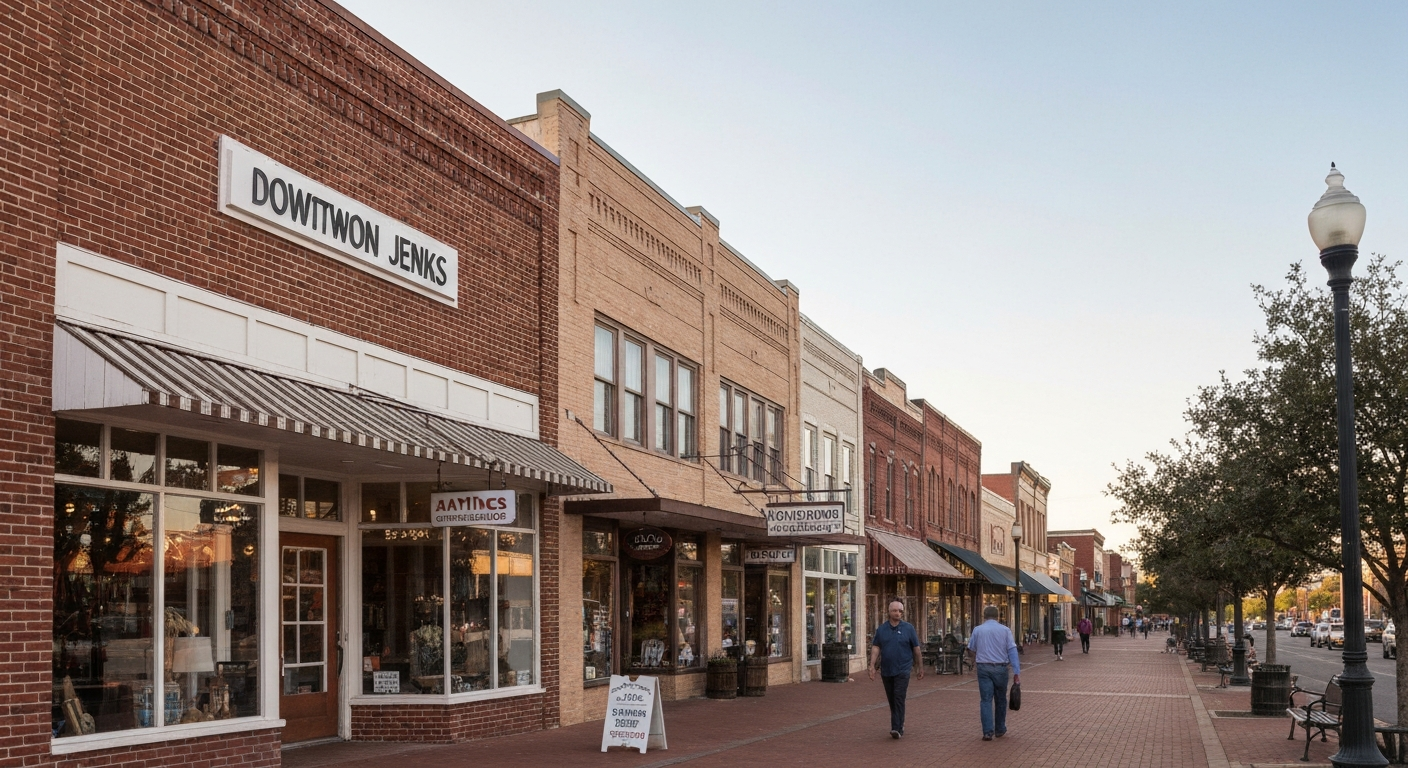
Jenks is home to the Oklahoma Aquarium, a regional attraction that draws visitors from across Oklahoma and surrounding states year-round. The city is also known as the “Antique Capital of Oklahoma” — the downtown antique district along Main Street pulls shoppers from across the state who come specifically to browse and buy. These two attractions give Jenks something most suburbs don’t have: a destination economy where people drive to Jenks to spend money, even if they live somewhere else.
Major employers provide economic stability beyond tourism and retail. Kimberly-Clark has operated a manufacturing facility in Jenks since the 1980s. First Oklahoma Bank is headquartered here. Green Country Energy provides utility-sector employment. And Jenks Public Schools — a recipient of the Malcolm Baldrige National Quality Award in 2005 — is consistently rated among the best school systems in Oklahoma. The school reputation is a major driver of residential demand, which in turn drives commercial demand. Families move to Jenks for the schools and then need places to eat, shop, and access services.
A newer initiative worth watching is The Ten District, a citizen-led revitalization effort launched in 2024 to restore abandoned infrastructure and create a new mixed-use destination within the city. It’s still in early stages, but the project signals the kind of investment energy flowing into Jenks beyond the established Main Street and Aquarium areas.
Step 1: Choose Your Business Structure
An LLC costs $100 to file with the Oklahoma Secretary of State at sos.ok.gov. After formation, your ongoing state cost is just $25/year for the Annual Certificate, due on your formation anniversary. That $25 payment is your entire annual obligation to the state for maintaining your LLC — Oklahoma repealed its franchise tax effective January 1, 2024, so there’s no additional annual entity tax.
To put that in perspective: an LLC in Oklahoma costs $25/year to maintain. In California, the minimum franchise tax alone is $800/year. In Texas, the franchise tax threshold is higher but still applies to larger businesses. Oklahoma’s maintenance costs are among the lowest in the country, period.
A corporation costs $50 to file with the same $25/year Annual Certificate. This option is less common for small businesses in Jenks, but it’s appropriate if you plan to issue stock or bring in outside investors.
A sole proprietorship requires no state filing and no ongoing fees. But you lose all personal liability protection, which means your personal bank accounts, your home, and your other assets are exposed if your business is sued or can’t pay its debts. In a market as affluent as Jenks, where customer expectations are high and commercial leases represent serious commitments, operating without liability protection is a risk most owners shouldn’t take.
You can also reserve a business name with the Secretary of State for $10 — optional but useful if you’ve landed on the right name and need time before filing your full formation paperwork.
Step 2: State Tax Registration
Register for your Oklahoma Sales Tax Permit through OkTAP (oktap.tax.ok.gov). The permit costs $20 plus a handling fee and is required for any business selling taxable goods or services in Oklahoma. This is the document Jenks will ask for when you apply for your city business license, so you need it in hand before moving to Step 3.
Oklahoma has no general business license at the state level. The Sales Tax Permit is your primary state-level business registration. It authorizes you to collect sales tax and obligates you to remit it to the Oklahoma Tax Commission on a regular schedule. If you’re selling goods or taxable services — which covers nearly every consumer-facing business — you need this permit.
When you register at OkTAP, you can simultaneously register for employer withholding tax if you plan to hire employees. This saves you a second trip through the registration process.
Workers’ compensation insurance is mandatory for all employers in Oklahoma. There’s no minimum employee threshold — your very first hire triggers this requirement. Get coverage through CompSource Mutual or a private carrier before bringing anyone on board. The penalty for operating without workers’ comp when you have employees is severe, including fines and personal liability for workplace injuries.
Get your EIN (Employer Identification Number) from the IRS before registering at OkTAP — you’ll need it for the registration. The EIN is free and available instantly at irs.gov/ein.
Step 3: City Business License
Jenks requires a local business license for businesses operating within city limits. Unlike neighboring Bixby, which uses an online MyGov portal, Jenks handles licensing more directly through the City Clerk’s office. The process involves more personal interaction with city staff, which can actually be an advantage — especially for business types that have multiple permit requirements.
City of Jenks: 211 N. Elm St, Jenks, OK 74037 Phone: (918) 299-5883 Website: jenks.com
Bring your Oklahoma Sales Tax Permit when you apply — it’s required documentation for the city license. The city needs to verify that you’re registered with the state before issuing local permission to operate.
Specific requirements vary by business type. A standard retail shop or professional office has a straightforward application. Businesses involving food service, alcohol sales, or home-based operations have additional permit layers that may require coordination with other agencies (the Tulsa Health Department for food, the ABLE Commission for alcohol, the Planning Department for home-based zoning compliance).
Contact the City Clerk’s office before your visit to confirm what documents you need for your specific business type. A quick phone call to (918) 299-5883 can save you from showing up with an incomplete application package.
The in-person process has an upside that shouldn’t be overlooked. In smaller cities like Jenks, the City Clerk staff often knows the local commercial landscape personally — available spaces, landlords, and the recent history of business activity in particular locations. Don’t treat the license visit as purely transactional. The people processing your application may have useful local knowledge about your market, your neighborhood, or specific permits that apply to your business type.
The Sales Tax Advantage
This is the number that should shape your pricing strategy and marketing position. Jenks’ city sales tax rate is 3.55% — the lowest of any major suburb in the Tulsa metro area.
The combined rate in Jenks (within Tulsa County) comes to approximately 8.42%: state 4.5% + Tulsa County 0.367% + city 3.55%, per Avalara 2026 data.
Here’s how that compares to your competition:
- Bixby: 8.92%
- Owasso: 8.87%
- Sand Springs: 8.92%
- Tulsa: 8.517%
- Jenks: 8.42% (lowest)
On a single $100 purchase, the difference between Jenks’ 8.42% and Bixby’s 8.92% is 50 cents. That sounds negligible on one transaction. But compound it across a full year of business and across your entire customer base, and the math becomes significant. On $500,000 in annual taxable sales, your Jenks customers collectively pay roughly $2,500 less in sales tax than they would at an identical business in Bixby or Sand Springs.
For restaurants, where the average ticket might be $40-$60 per table and tables turn multiple times per day, the lower tax rate means lower total-on-the-check amounts. Customers may not consciously compare tax rates, but their total spending capacity stretches further in Jenks than in neighboring cities. For larger purchases — furniture, electronics, auto services — the savings become more noticeable on each individual receipt.
One essential caveat: Oklahoma uses destination-based sales tax sourcing. If you’re shipping products to customers in other cities, you charge their local rate, not yours. The 3.55% city rate advantage only applies to walk-in customers who purchase from you at your Jenks location. For brick-and-mortar retail, dine-in restaurants, and in-person service businesses, that’s exactly the customer base that matters most.
The Destination Economy
Most Tulsa suburbs are residential communities — people live there and drive elsewhere to shop, eat, and be entertained. Jenks is different. People drive to Jenks specifically to spend money, even if they live in Tulsa, Broken Arrow, or Bixby.
The Oklahoma Aquarium is the biggest driver of this pattern. As a major regional attraction, it draws visitors year-round — families on weekends, school groups on field trips, out-of-town guests looking for activities. These visitors park, walk around, eat lunch, and browse nearby shops. If your business is within a few minutes of the Aquarium, you benefit from foot traffic you didn’t have to generate through your own marketing.
The antique district along Main Street creates a different but equally valuable traffic pattern. Antique shoppers are a targeted demographic with specific characteristics that benefit surrounding businesses: they arrive in a buying mindset, they browse multiple stores in a single visit (which means time spent in the area), and they tend to eat at nearby restaurants between shopping stops. The “Antique Capital of Oklahoma” branding gives Main Street a regional identity that draws shoppers from well beyond the Tulsa metro.
Jenks hosts several annual events that create additional traffic spikes: the Jenks Herb and Plant Festival in April, the Food Truck Festival, Boomfest on the Fourth of July, and Art on Main in October. Each event brings an influx of visitors who may not otherwise visit Jenks during a normal week. Some percentage of those visitors discover local businesses they didn’t know about and become regular customers.
The practical implication for your business plan: your addressable market in Jenks is significantly larger than the city population of 27,869 suggests. A restaurant on Main Street isn’t limited to Jenks residents — it’s serving the entire flow of Aquarium visitors, antique shoppers, and event attendees. A retail shop in the downtown district benefits from destination traffic that suburbs like Owasso or Sand Springs simply don’t generate.
When projecting revenue, don’t limit your market size to Jenks’ population. Factor in the destination traffic, especially if you’re locating near Main Street or the Aquarium area.
Tribal Jurisdiction Note
Jenks falls within the Muscogee (Creek) Nation reservation boundaries under the Supreme Court’s McGirt v. Oklahoma decision (2020). For most small businesses, this primarily affects criminal jurisdiction — your city and state business licenses remain required and valid regardless of the McGirt ruling.
If you’re leasing commercial space and want to confirm whether the property sits on tribal trust land (which could add a licensing requirement), contact the Muscogee (Creek) Nation Commerce Department for clarification. This applies to a small percentage of properties, but it’s worth checking if you’re unsure about the land status of a specific commercial space.
For the vast majority of Jenks businesses — shops on Main Street, restaurants near the Aquarium, professional offices, home-based services — the McGirt decision doesn’t change your licensing requirements or day-to-day operations.
Costs at a Glance
Government fees to launch a basic LLC in Jenks:
- LLC filing: $100 (one-time) + $25/year Annual Certificate
- Sales Tax Permit: $20 (one-time)
- City business license: Varies by type
- EIN from IRS: Free
- Workers’ comp (if hiring): Varies by industry classification
- Name reservation (optional): $10
What you won’t pay: no franchise tax (repealed 2024), no city income tax, no state E-Verify mandate.
Total first-year government fees for a basic LLC: approximately $150 to $200. That’s before insurance, rent, and industry-specific costs — but the government’s share at launch is minimal.
The real advantage of starting in Jenks isn’t just low government fees — every Oklahoma city has low government fees. What sets Jenks apart is the combination of the lowest sales tax rate in the Tulsa metro, a destination economy that brings paying customers to your doorstep, and a school system that keeps driving residential (and therefore commercial) demand. Those three factors working together create a business environment that justifies higher commercial rents while still delivering strong customer volume and spending power.
One thing to keep in mind about ongoing costs: the $25/year Annual Certificate to the Oklahoma Secretary of State is due on the anniversary of your formation date, not on a calendar-year schedule. If you form your LLC on March 15, your Annual Certificate is due every March 15. Mark it on your calendar — missing the filing doesn’t immediately dissolve your LLC, but it puts you in “delinquent” status, which can complicate future filings and make you ineligible for certain contracts and licenses until resolved.
Your workers’ compensation premium — if you have employees — will be your most significant ongoing insurance cost. Rates vary by industry classification and your claims history, but expect to budget several percent of payroll. For restaurants and retail (the most common Jenks business types), workers’ comp rates are moderate. For construction or manufacturing, they’re higher. Get quotes from CompSource Mutual and at least one private carrier before your first hire so you can compare rates.