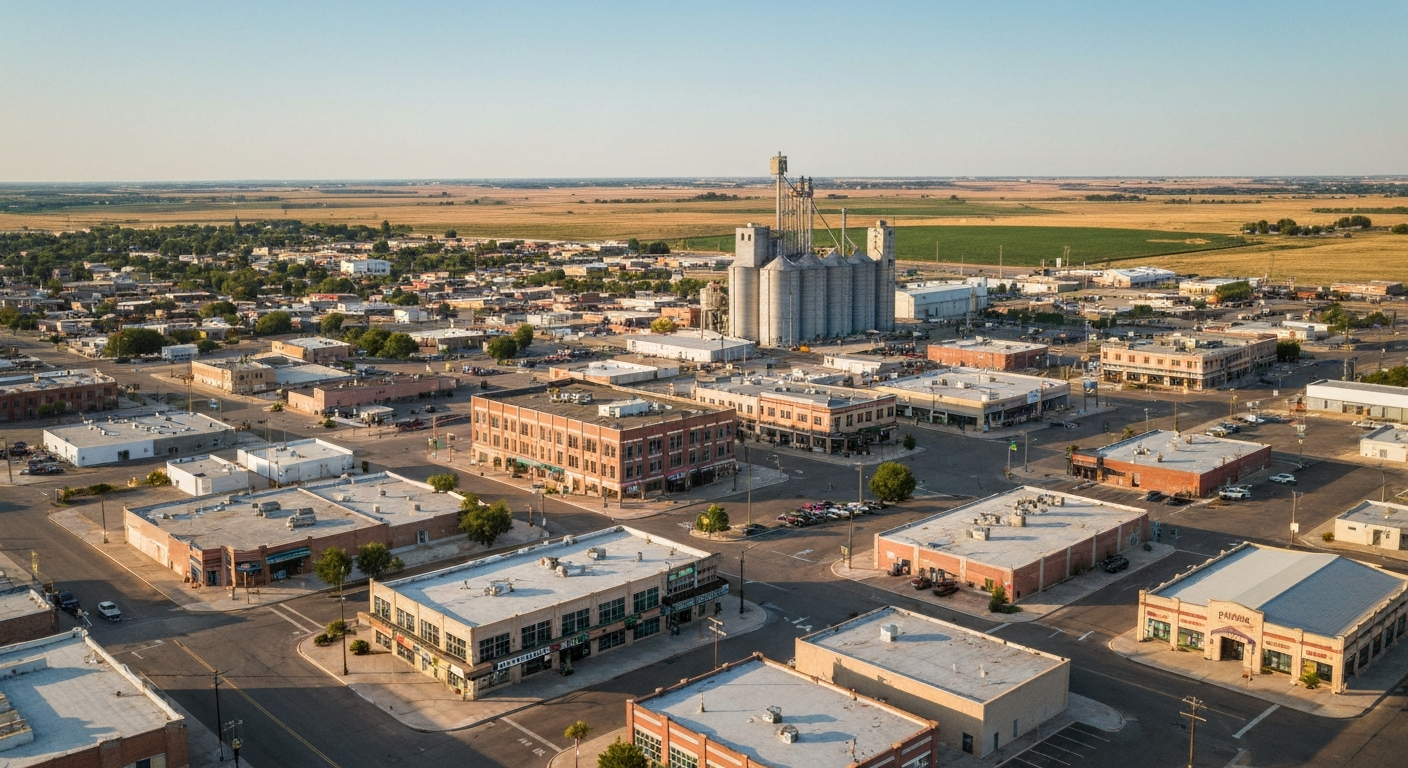
How to Start a Business in Enid, Oklahoma
How to Start a Business in Enid, Oklahoma
Enid isn’t Oklahoma City or Tulsa. It’s a 50,000-person regional hub in the state’s northwest corner where wheat money, military spending, and agricultural infrastructure collide. That’s the point.
If you’re thinking about starting a business here, you’re not building a satellite office or a side hustle in someone else’s shadow. You’re opening in a city where Vance Air Force Base keeps the lights on, where farmers and ranchers have real capital to spend, and where the nearest comparable commercial infrastructure is 100+ miles away. Enid’s business opportunity isn’t flashy. It’s structural. People here need things. They have money. And many of them currently drive to OKC or Tulsa to get what they want.
The process to get your doors open is straightforward — Oklahoma’s filing costs are lower than most neighboring states, there’s no franchise tax, and Enid’s local requirements are manageable. But you need to understand how this city’s economy actually works before you pick a location or a product.
Here’s what you need to know.
Why Start a Business in Enid?
Enid is Oklahoma’s ninth-largest city and the economic capital of northwest Oklahoma. Population is roughly 50,519 as of 2024. The median household income sits around $63,472 — solidly middle-class, and above Oklahoma’s statewide median. That means your customer base has money to spend.
The military is the foundation. Vance Air Force Base is Enid’s largest single employer, with approximately 1,300 civilian workers on payroll plus military personnel stationed there. The base generates hundreds of millions in annual economic impact for the region — housing allowances, commissary spending, contractor work, and supply chain activity ripple through the local economy constantly. Military bases don’t close on a whim. That’s stability that smaller towns can’t promise.
But Vance isn’t the whole story. Enid’s economy is built on agriculture, energy, and manufacturing.
The wheat is real. Garfield County and the surrounding region produce millions of bushels annually. That drives grain handling, equipment sales, fertilizer distribution, and logistics. Oil and gas operations continue to operate in the area — not boom-time volume, but consistent activity. Koch Industries has operations here. Groendyke Transport, one of the region’s largest trucking companies, is based in Enid. Atwoods Ranch & Home, a major regional retail chain, has its headquarters here. AdvancePierre Foods, a food manufacturing company, operates a facility in the city.
The healthcare sector is growing. Enid employs roughly 3,700 people in health care and social assistance — a significant workforce for a city this size, and a sign of demographic stability and aging infrastructure that requires ongoing services.
Here’s what makes Enid different from starting in a suburb of OKC or Tulsa: Enid is a regional trade center. People drive from surrounding rural areas of Garfield County and neighboring counties to shop, get services, and do business here. There’s no comparable commercial infrastructure within 45+ minutes in any direction. That creates a captive market — not geographically trapped, but economically concentrated around Enid’s retail, service, and professional sectors.
With $63K median household income, that customer base can spend. And they’re currently spending time and money traveling to larger cities for things Enid doesn’t have.
Step 1: Choose Your Business Structure
Your first real decision is whether to operate as a sole proprietorship, LLC, or corporation. This affects liability protection, tax filing, and ongoing costs.
LLC is the default choice for most new businesses. It costs $100 to file your Articles of Organization at sos.ok.gov (the Oklahoma Secretary of State), and it’s a one-time payment. Once you’re formed, your ongoing cost is $25 per year for the Annual Certificate, due on the anniversary of your formation date. That’s it.
No franchise tax. Oklahoma repealed its franchise tax effective January 1, 2024. Historically, it applied only to corporations (LLCs were already exempt), but the point stands: you’re not paying an annual franchise tax to operate in Oklahoma, unlike California ($800 minimum) or Texas (which has a gross revenue-based franchise tax). Your ongoing state cost is $25 annually.
A corporation costs $50 to file and is subject to the same $25 annual certificate fee. Corporations make sense if you’re planning significant capital investment, multiple owners with different profit-sharing arrangements, or if you want to issue stock. For most small businesses starting in Enid, an LLC is simpler and cheaper.
A sole proprietorship has no state filing requirement. You just start operating under your own name. The tradeoff: you have zero liability protection. If someone sues your business, they’re suing you personally. Your personal assets are at risk. For a service business with minimal liability risk, this might work. For anything else — retail, food service, manufacturing — the $100 LLC cost is insurance you can’t skip.
How does Oklahoma compare to neighboring states? Texas charges $300 to file an LLC and $0 for an annual report, but Texas’s franchise tax applies based on gross revenue — potentially thousands annually for a successful business. Kansas charges $160 for an LLC and $55 for an annual report. Oklahoma’s $100 + $25/year is the cheapest to maintain long-term.
You can file your LLC online at sos.ok.gov, or mail your Articles of Organization to the Oklahoma Secretary of State at 421 NW 13th Street, Suite 210, Oklahoma City, OK 73103. Phone: (405) 521-3912. Online filing is faster. You can also request a name reservation for $10 if you want to secure your business name before filing your full formation documents.
Step 2: Register for State Taxes
Oklahoma has no general business license at the state level. That might sound odd if you’re coming from another state. Here’s what it means: your primary state registration is your Sales Tax Permit.
Register at OkTAP — Oklahoma Taxpayer Access Point — at oktap.tax.ok.gov. The Sales Tax Permit costs $20 plus a handling fee and is required for any business selling taxable goods or services in Oklahoma. That includes retail stores, restaurants, contractors, service providers — essentially everything except a pure consulting or professional services business that operates solely on hourly fees.
You register at the same time for employer withholding tax if you’re hiring employees. Do both at once.
Workers’ compensation insurance is mandatory for all employers in Oklahoma. There is no minimum employee count. If you hire even one person, you need coverage. You can obtain it through CompSource Mutual (formerly CompSource Oklahoma) or through a private insurance carrier. You must have coverage in place before your first hire. This is non-negotiable and enforced — employers operating without workers’ comp face significant penalties.
Get your Sales Tax Permit and employer withholding registration set up before you apply for your Enid business license. You’ll need a copy of your permit when you apply locally.
Step 3: Get Your Enid Business License
Enid requires a city business license for any business operating within city limits. This is separate from your state registration.
Apply through the City of Enid. The Business License Application is available at enid.org/i-want-to/apply-as-for/business-licenses. You can also reach the Community Development department directly, which handles business license applications.
City of Enid — Dr. Martin Luther King Jr. Municipal Complex 401 W. Owen K. Garriott Road Enid, OK 73701 Phone: (580) 234-0400
When you apply, you’ll need to provide a copy of your Oklahoma Sales Tax Permit. The city will review your application, verify your location’s zoning compliance, and issue your license. License costs vary by business type — there’s no flat fee. A small retail or service business might pay $50–150; a manufacturing operation or larger commercial venture could pay more. Ask the Community Development department for the specific fee schedule for your business category.
Additional forms and applications are available at enid.org/I-Want-To/View/Forms-and-Applications. If you have specific questions about your business type or location, call (580) 234-0400 before applying.
Step 4: Handle Zoning and Location
This is where location strategy intersects with regulation.
Enid’s Community Development department reviews commercial locations before you receive your business license. The city has zoning ordinances that govern what type of business can operate in which area. This isn’t a gotcha — it’s standard — but it’s worth understanding before you sign a lease or buy a property.
Major commercial corridors in Enid include Owen K. Garriott Road (US-412), Van Buren Street, and the Enid town center. These are your primary retail and service locations. Most of Enid’s existing commercial activity clusters here, and zoning in these areas is designed for commercial use.
If you’re considering a home-based business, check Enid’s zoning ordinances carefully. Residential zones have restrictions on home occupations. Limits typically include signage (none visible from the street, or very limited), customer visits (either prohibited or limited to a small number), and employee counts (usually limited to family members or one outside employee). You can operate a consulting business, virtual business, or freelance service from home if it’s low-traffic. You cannot run a retail store, restaurant, or manufacturing operation from a residential property in most Enid neighborhoods.
Building permits are required for any construction, renovation, or modification to a commercial space. If you’re leasing an existing retail or office space that’s already built out, you might not need a permit. If you’re doing any buildout, interior work, or signage installation, you’ll need one. Permits are issued through the City of Enid’s Community Development department — same contact as above.
Start by contacting the city about your specific location before you commit to a lease. A 20-minute conversation with the zoning administrator will save you weeks of headaches later.
Sales Tax: What You’ll Collect
Enid’s combined sales tax rate is 9.1%. That breaks down as follows: Oklahoma state rate of 4.5%, plus Garfield County at 0.35%, plus Enid city at 4.25%.
The city’s 4.25% rate is on the higher side for Oklahoma. Bartlesville, a comparable regional hub in northeast Oklahoma, sits at 3.4%. Stillwater is 3.875%. Enid is notably higher. For retail businesses, this matters because customers pay it, and it affects price competitiveness compared to shopping in smaller surrounding towns or driving to OKC for big purchases.
For your business, it matters because you’re collecting it on behalf of the state and city, and you’re filing returns to remit it.
Oklahoma uses destination-based sales tax. You charge the rate at the buyer’s delivery address, not where your business is located. This is critical if you’re a delivery-based business (plumbing, HVAC, landscaping), an online seller, or a service provider working across city and county lines. If you deliver a service to someone in a different city with a different tax rate, you charge their local rate, not Enid’s. If you sell and ship products to a customer in another state, you don’t charge Oklahoma sales tax (the purchaser’s state handles that, if applicable).
You file and remit sales tax through OkTAP monthly, quarterly, or semi-annually depending on your sales volume. Lower-volume businesses file less frequently. OkTAP will tell you your filing schedule based on your expected sales when you register.
Costs at a Glance
Here’s the total cost to get your business legally open in Enid, broken down:
- LLC filing: $100 (one-time) at sos.ok.gov
- Annual Certificate: $25 per year (due each anniversary)
- Sales Tax Permit: $20 (one-time) at OkTAP
- Enid business license: Varies by type; typically $50–150 for a small business
- Workers’ compensation insurance (if hiring): Varies by industry and number of employees; typically $500–2,000+ annually for a small business with one or two employees
Total first-year costs for a basic LLC with a business license and no employees: approximately $150–200 in government fees.
If you’re hiring, add workers’ compensation insurance. If you’re filing a corporation instead of an LLC, substitute $50 for the $100 LLC fee.
Oklahoma has no franchise tax, no city income tax, and no state E-Verify mandate. Those are real cost savings compared to other states.
What Makes Enid Different
Enid is a real city with a real economy, not a commuter suburb. Vance Air Force Base isn’t going anywhere — military bases are among the most stable employers in America — and the agricultural and energy sectors have deep roots here.
The seasonal demand patterns matter. Spring and early summer bring planting season activity — equipment sales, fertilizer distribution, logistics. Fall is harvest. Winter is quieter. Healthcare and military spending are year-round, but understanding the agricultural cycle helps you forecast cash flow and staffing needs.
The regional trade center status is your opportunity. People from surrounding rural areas need services and products that don’t exist within reasonable driving distance. If you can identify an unmet need in Enid, you have a protected market. The $63K median household income means they can afford it.
Enid also isn’t in tribal jurisdiction territory. It’s in Garfield County in northwest Oklahoma, well outside the eastern Oklahoma tribal boundaries affected by McGirt v. Oklahoma. You don’t need a tribal business license in addition to your city and state registrations.
The bottom line: the filing process is cheaper than Texas or Kansas, faster than dealing with California’s regulations, and straightforward. You can be legally open in about two weeks if you move fast. The real work is understanding your market, finding your location, and building your customer base.
Vance AFB and the agricultural sector create a stable customer base. The regional trade center position creates opportunity. Your job is to fill a gap that currently sends Enid’s residents elsewhere.