How to Get a Business License in Chickasha, Oklahoma
How to Get a Business License in Chickasha, Oklahoma
You’re ready to open a business in Chickasha. You’ve got the business plan, the location, maybe even the first customer lined up. Now you need the legal piece: a business license from the City of Chickasha.
Here’s what you need to know upfront: Oklahoma doesn’t have a state-level general business license. That means your operating authority comes from two sources—your local city license (from Chickasha) and your Oklahoma Sales Tax Permit. Both matter. Both are required. And there’s a specific order in which you need to get them.
The good news is Chickasha’s City Clerk’s Office handles this process clearly. They publish their fees, their application forms are downloadable online, and they keep standard business hours—unlike some smaller Oklahoma cities that operate on limited schedules. This guide walks you through the exact sequence from entity formation to legally operating your business in Chickasha.
What Chickasha Requires
If you’re operating within Chickasha city limits—whether you’re running a retail store on 4th Street, a service-based business in the downtown district, or even a home-based operation in a commercially zoned area—you need a Chickasha city business license.
This is strictly a local requirement. Oklahoma’s state government doesn’t issue a catch-all business license. Instead, each city and county handles its own licensing. Chickasha’s requirement is straightforward: you apply to the City Clerk’s Office, pay the applicable fee for your business type, and you’re licensed to operate within city limits.
Your city business license alone isn’t enough, though. You also need an Oklahoma Sales Tax Permit. Together—your city license plus your state sales tax permit—these form your complete operating authority. One without the other leaves you incomplete and, legally speaking, not fully compliant.
The distinction matters because the city license is about local control and municipal records. The sales tax permit is about state taxation and revenue collection. They serve different purposes and they come from different agencies. Both are non-negotiable if you’re selling goods or services in Oklahoma.
The Prerequisite Chain
Here’s where the sequence matters. You can’t just walk into the City Clerk’s Office and get a license tomorrow. There are prerequisite steps, and they have to happen in order.
Step 1: File your business entity with Oklahoma Secretary of State.
Before you’re licensed by the city, you need a legal business entity. In Oklahoma, that means filing Articles of Organization for an LLC ($100 filing fee) or Articles of Incorporation for a corporation ($50 filing fee) with the Oklahoma Secretary of State.
You can file online at sos.ok.gov, which is faster than mailing. Most people choose an LLC for simplicity—it offers liability protection without the extra compliance burden of a corporation. The filing is straightforward and takes less than an hour.
The Secretary of State’s office is located at 421 NW 13th Street, Suite 210, Oklahoma City, OK 73103. You can also call (405) 521-3912 if you have questions, but filing online avoids the phone lines entirely.
Once your entity is filed, you have a legal business name and a registered business in Oklahoma. You’re not yet licensed, but you’re recognized.
Step 2: Get your EIN from the IRS.
An EIN—an Employer Identification Number—is your business’s tax ID. Even if you’re a solo operation with no employees, you need one. The IRS issues them for free, instantly, at irs.gov/ein.
You can apply online in minutes. You’ll answer questions about your business structure (LLC, corporation, etc.), location, and business type. The IRS will give you your EIN immediately. Write it down. You’ll need it for the next step.
This is not an Oklahoma-specific step—it’s federal. But it’s essential for state tax registration, so it goes here in the sequence.
Step 3: Register for your Oklahoma Sales Tax Permit.
Oklahoma taxes sales through the Oklahoma Tax Commission. You register and apply for permits through OkTAP, the Oklahoma Taxpayer Access Point, at oktap.tax.ok.gov.
You’ll create an account, provide your business information, and apply for a Sales Tax Permit. The fee is $20, plus handling charges (exact total depends on your county). The permit covers all taxable goods and services you sell in Oklahoma.
This step is critical because Chickasha won’t issue your city license without proof of this state permit. Many first-time business owners skip this or forget it, then show up at the City Clerk’s Office unprepared. Don’t be that person. Get your sales tax permit first.
When you apply at OkTAP, you’ll also be able to register for employer withholding and corporate income tax if those apply to your business. But the sales tax permit is the minimum.
Step 4: Apply for your Chickasha city business license.
Now you have everything in hand: a registered business entity, an EIN, and a sales tax permit. This is when you contact the City Clerk’s Office in Chickasha and apply for your local business license.
You’ll need your sales tax permit number. The city will verify it. They’ll ask about your business type, your location, and the nature of your operations. You’ll pay the applicable fee, and you’re licensed.
This sequence takes a few days to a couple of weeks, depending on how quickly you move through each step. But it’s straightforward. There’s no guessing, no backtracking.
Where to Apply
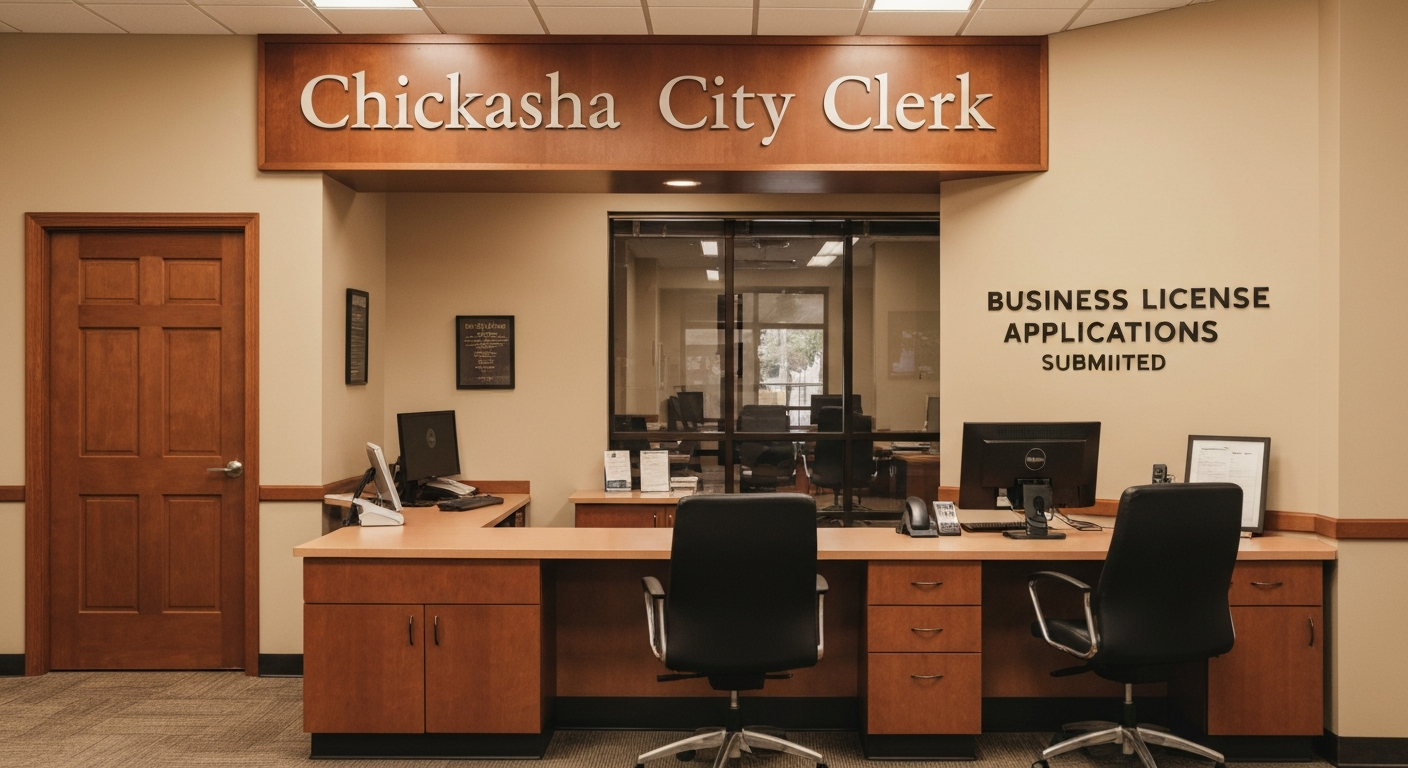
The City Clerk’s Office in Chickasha is your single point of contact for a business license.
Address: 117 N 4th Street, Chickasha, OK 73018
Phone: (405) 222-6001
Fax: (405) 222-6004
General city number: (405) 222-6020
Email: [email protected]
Hours: Monday–Friday, 8:00am–5:00pm
Website: chickasha.gov
Chickasha maintains standard business hours, which is a genuine convenience. Some smaller Oklahoma cities operate on limited schedules—two days a week, or afternoons only. Chickasha’s Monday–Friday 8–5 schedule means you can stop by during a typical workday without special planning.
The city also publishes application forms on its website at chickasha.gov. Download them in advance, fill them out before you go in, and you’ll save time in the office. The forms ask for your business name, entity type, location, nature of business, and your sales tax permit number.
You can apply in person during business hours or submit forms by mail or email. In-person applications are fastest—you can ask questions on the spot if the form is unclear, and you can resolve any issues the same day. But the city does accept remote applications if that’s more convenient for your schedule.
Bring your sales tax permit (or a printout showing your permit number from OkTAP) when you apply. This is the one document the city will require as proof that you’ve completed the state prerequisite.
The Fee Schedule
Chickasha publishes an annual fee schedule that covers all municipal permits and licenses. The most recent update was June 2024. This document outlines fees for business licenses, building permits, zoning variances, and every other license the city issues.
The fee schedule is available at chickasha.org or directly from the City Clerk’s Office. You can download it online, or call (405) 222-6001 and they’ll email or mail it to you.
Business license fees vary significantly by business type. A basic occupational license might cost $50. A retail operation could be $75–$150. Heavily regulated uses—alcohol sales, hotels, motels, certain food service operations—carry substantially higher fees, sometimes several hundred dollars.
Because fees are category-specific and the schedule is the official source, I won’t quote exact figures here. Instead, call the City Clerk at (405) 222-6001 and tell them your business type. They’ll quote you the exact fee from the current schedule. This takes five minutes and ensures you have the right number.
The fee is typically a one-time cost for the initial license, though renewal fees may apply depending on your license type. Again, the fee schedule will specify.
Industry-Specific Requirements
Some businesses need more than just a city license. Certain industries in Oklahoma require state-level licenses or permits in addition to your Chickasha city license. Know whether your business is one of them.
Food service. If you’re operating a restaurant, food truck, catering business, or any food establishment that serves the public, you need an Oklahoma Department of Health food establishment license in addition to your city license. The health department conducts inspections and certifies that your facility meets food safety standards. This is non-negotiable and must be obtained before you open. Apply at the Oklahoma Department of Health website or contact your local health department office.
Alcohol. If you’re selling beer, wine, or liquor—whether on-premises (bar, restaurant) or off-premises (liquor store, convenience store)—you need a license from the Alcoholic Beverage Laws Enforcement (ABLE) Commission at the state level, plus a city alcohol permit from Chickasha. The ABLE Commission is the state regulator; the city permit is your local authorization. Both are required, and ABLE’s process is rigorous and time-consuming. Plan for several weeks.
Contractors. If you’re doing construction work and your contract exceeds $50,000, you need a license from the Oklahoma Construction Industries Board. This applies to general contractors, subcontractors, and specialty contractors (electrical, plumbing, HVAC, etc.). The board verifies your insurance, bonding, and qualifications. For smaller jobs, you may not need a state license, but verify with the board based on your specific scope of work.
Agricultural businesses. Grady County has a significant agricultural base. If your business involves livestock, pesticide application, custom farming, grain handling, or similar operations, check with the Oklahoma Department of Agriculture, Food, and Forestry. Some agricultural operations require state permits or registrations. The specifics depend on what you’re doing and what you’re handling.
Home-based businesses. If you’re operating from your residence, you need to verify that your home occupation complies with Chickasha’s zoning restrictions. More on this in the next section.
Don’t assume your business falls outside these categories. If you’re uncertain, ask the City Clerk when you apply. They know the local requirements and can point you toward state regulators if needed.
Zoning in Chickasha
Chickasha’s commercial districts are concentrated in specific areas of the city. Knowing where these zones are matters because you can’t operate a business in a residential zone without approval, and you can’t operate a home-based business without zoning compliance.
The main commercial corridor runs along US-81, which is 4th Street through downtown Chickasha. This is the heart of retail and service businesses in the city. US-62 also has commercial zoning. The downtown business district, centered around the 4th Street area, is clearly zoned for business.
The area around the University of Science and Arts of Oklahoma (USAO) campus has mixed commercial and residential zoning. Some parcels allow business; others don’t. If you’re considering that area, check with the city before committing to a location.
If you’re running a home-based business—a consulting firm, freelance writing, bookkeeping, virtual services, or anything operated from your residence—you need to comply with Chickasha’s home occupation restrictions. Residential zones have limits on the type of business, the number of employees, signage, parking, and noise. You can’t run a manufacturing operation or a high-traffic retail business from your home. But many service-based and professional businesses qualify.
Contact Chickasha’s Planning Department or the City Clerk’s Office to verify that your home-based operation meets zoning requirements. They’ll tell you if your business type is allowed in your residential zone, and if any restrictions apply.
If you’re modifying an existing building, renovating space, or changing the use of a property, you’ll need a building permit from the city. This is separate from your business license. The building and zoning review happens before or alongside your business licensing. Again, the City Clerk’s Office or Planning Department can guide you through this.
Renewal and Compliance
Getting your business license is step one. Keeping it active and staying compliant is ongoing.
License renewal. Your city business license will have an expiration date. Some licenses are annual; others may have different renewal cycles. Check your license for the expiration date and renewal deadline. The City Clerk’s Office will send you a renewal notice as the date approaches, but don’t rely on that. Mark your calendar. Late renewal fees or license suspension can disrupt your operations.
Sales tax compliance. Your Oklahoma Sales Tax Permit requires active maintenance. You must file sales tax returns and remit tax through OkTAP on a schedule—monthly, quarterly, or annually depending on your sales volume and business type. Missing a filing deadline or underpaying tax can result in penalties and interest. Stay on top of this. It’s the most common compliance failure for small businesses.
Display your license. Oklahoma law requires you to display your business license at your place of business, in a location visible to customers and employees. Don’t hide it in a filing cabinet. Post it prominently. It’s proof of legitimacy and shows customers you’re operating legally.
Stay connected to local resources. Chickasha has two business support organizations worth joining:
The Chickasha Chamber of Commerce (chickashachamber.com) provides networking opportunities, business referrals, and access to local business information. Membership keeps you connected to the business community and often includes exposure to potential customers.
The Chickasha Economic Development Council (chickashaedc.com) offers resources for new and expanding businesses. They publish a “Doing Business in Chickasha” guide that covers local incentives, workforce information, utilities, and other practical details for operating in the city. This is a free resource and worth reading.
Staying compliant isn’t burdensome if you stay organized. Mark renewal dates in your calendar. Set reminders for tax filing deadlines. Keep your business license posted. Respond promptly if the city or state contacts you about anything. Simple habits prevent problems.
Getting licensed to operate in Chickasha is straightforward when you follow the sequence: register your business entity, get your EIN, apply for your sales tax permit, then apply for your city license. The City Clerk’s Office at 117 N 4th Street makes the final step easy with standard hours, downloadable forms, and a published fee schedule.
Your next move: contact the Oklahoma Secretary of State to file your LLC or corporation. That’s step one. Once that’s done, the rest flows naturally.