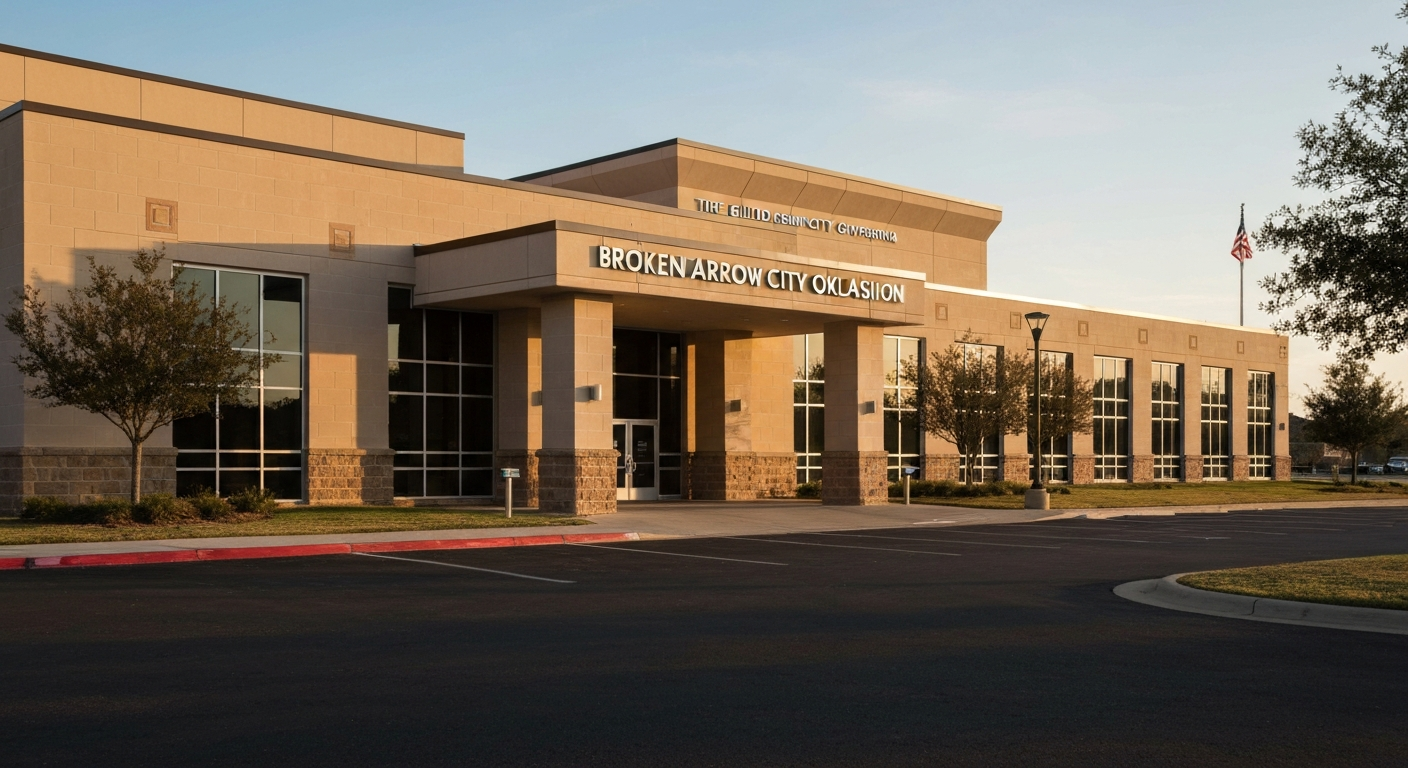
How to Get a Business License in Broken Arrow, Oklahoma
Broken Arrow has the lightest licensing touch in the Tulsa metro area. There is no general city business license, no annual occupation tax, and no business registration fee. The Building Permits Division is known among developers for processing applications faster than Tulsa’s equivalent offices. If you’re comparing permitting timelines across the metro, BA consistently comes out ahead.
The one thing most guides get wrong about Broken Arrow is the sales tax rate. Because the city straddles two counties and multiple special tax districts, the rate your business owes depends on your exact street address — not your ZIP code, not a single city-wide number. This guide covers that trap and everything else you need to know about licensing a business in BA.
Broken Arrow Licensing: Fast and Light
No general city business license. No annual occupation tax or business registration fee. Broken Arrow’s permitting model is built on speed and simplicity, and that’s a deliberate choice by the city government to attract businesses.
What you need to operate legally:
- Sales Tax Permit (state, $20 through OkTAP)
- Certificate of Occupancy (city, for commercial locations)
- Industry-specific permits (only if your business type requires them)
That’s the entire list for most businesses. No zoning verification fee. No annual renewal. No gross receipts assessment.
Broken Arrow’s reputation among Oklahoma developers is “faster permitting and more flexible zoning than Tulsa proper.” That reputation exists for a reason — the Building Permits Division processes applications efficiently, the zoning office works with developers rather than against them, and the city’s overall approach favors getting businesses open over creating bureaucratic obstacles. If your business plan depends on getting open quickly, BA’s permitting timeline gives you a concrete advantage over many other metro cities.
Compare this to cities in other states: Virginia charges a Business Professional and Occupational License (BPOL) tax. Georgia requires an annual Occupation Tax Certificate. California mandates a city business tax certificate. In Broken Arrow, none of these exist. The savings aren’t just in the first year — they compound annually for as long as you’re in business.
Step 1: Sales Tax Permit and the ZIP Code Trap
Apply for your Sales Tax Permit at the OkTAP portal (oktap.tax.ok.gov). Fee: $20 plus handling. Get your EIN from the IRS first (free at irs.gov/ein). You need the EIN before OkTAP will let you register.
Here’s where Broken Arrow businesses need to pay close attention. The city straddles Tulsa County and Wagoner County, and your combined sales tax rate depends on which side of the line your business sits on. A single “Broken Arrow sales tax rate” doesn’t exist.
Tulsa County side (most of Broken Arrow):
- 4.5% state + 3.55% city + 0.367% Tulsa County = 8.417% total
Wagoner County side:
- Higher county rate of 1.3% pushes the combined rate to approximately 9.35%+
Special district zones:
- Some ZIP codes, particularly 74012, show rates as high as 9.6% due to special district tax overlays
If you look up your rate by ZIP code alone, you may get the wrong number. ZIP codes don’t align with county boundaries or special district boundaries, and a single ZIP code in Broken Arrow can contain locations with rates that differ by more than a full percentage point. Use the OTC Rate Locator tool with your exact street address to get the correct combined rate for your location. Do this before you set up your point-of-sale system, before you print price tags, and before you file your first return.
The base BA rate on the Tulsa County side (8.417%) is lower than Tulsa’s rate of 8.517%. That 0.1% difference matters for high-volume retail businesses — on $1 million in annual sales, it’s a $1,000 difference that your Tulsa-based competitors are absorbing and you aren’t. For a small margin business, that’s meaningful.
File monthly sales tax returns by the 20th of the following month through OkTAP. Late filing carries a 10% penalty. A demand notice from the OTC adds 25% more. These stack — a $4,000 monthly obligation becomes $5,400 after both penalties. File on time, every month. Oklahoma uses destination-based sales tax, so if you ship products, charge the rate at the buyer’s delivery address. For in-store purchases, your location-specific rate applies.
Step 2: Certificate of Occupancy and Building Permits
The BA Building Permits Division handles Certificates of Occupancy, building permits, and inspections for all commercial properties. This is the department you’ll interact with most during your business setup.
Certificate of Occupancy (CO): Required for all commercial occupancy in Broken Arrow. You cannot legally operate from a commercial space without a valid CO. The process follows the standard sequence:
- Submit application to the Building Permits Division
- Plan review (if renovating or changing use)
- Building and fire inspections
- CO issued upon passing
Timeline: Typically faster than the Tulsa metro average. BA’s building department processes applications more quickly than comparable offices, which is one reason developers favor the city. Expect 1-2 weeks for straightforward applications. If your space requires significant renovation, the plan review step adds time but still moves faster than the metro norm.
If the previous tenant had a CO for a different business type, don’t assume it covers you. Changes in business type or ownership may require a new inspection. Confirm with the Building Permits Division before assuming you’re covered.
Construction requiring CIB-licensed contractors: Commercial projects exceeding $50,000 in value require a contractor licensed by the Oklahoma Construction Industries Board (CIB) for regulated trades (electrical, plumbing, mechanical, HVAC). City building permits are required for all construction work regardless of project size. Even minor renovations need a permit if they involve structural, electrical, or plumbing changes.
Home-based businesses: Permitted in Broken Arrow with standard residential restrictions. Verify with the city’s zoning office that your specific address and business type qualify before beginning operations. Restrictions typically cover signage, customer traffic, number of employees working on-site, and the percentage of your home used for business. BA is more flexible than some metro cities on this, but you still need to check.
Zoning verification: While BA is development-friendly, you still need to confirm your business type is permitted at your chosen address. The flexibility that developers appreciate comes from a responsive zoning process, not from the absence of zoning rules. Check before signing a lease — it’s a free phone call that can save you thousands in lost deposits.
Step 3: Industry-Specific Permits
Depending on your business type, you may need additional permits beyond the Sales Tax Permit and CO.
Food trucks and mobile vendors: The City of Broken Arrow requires food permits for mobile vendors. This is a separate process from brick-and-mortar restaurant permitting. Contact the BA City Clerk for the application, location restrictions, and any event-specific requirements. The Rose District and other high-traffic areas may have additional rules about where food trucks can operate.
Restaurants and food service: Broken Arrow falls within the Tulsa Health Department’s jurisdiction for food service inspections — there is no separate BA health department for this. You need three layers of approval:
- Tulsa Health Department food service permit (includes plan review and pre-opening inspection)
- Oklahoma State Department of Health (OSDH) food service establishment license
- City of Broken Arrow Certificate of Occupancy
Start the Tulsa Health Department plan review early. Submit it during your construction planning phase, not after the buildout. The plan review examines kitchen layout, equipment placement, ventilation, food storage, and sanitation — all things that are expensive to change after construction. It’s consistently the longest step for new restaurant openings in the Tulsa metro. Getting it started early is the single most important timeline decision for restaurant startups in BA.
Alcohol: ABLE Commission license at the state level (Alcoholic Beverage Laws Enforcement) plus City of Broken Arrow local approval. Mixed beverages carry a 6% mixed beverage tax. Apply for both the state and local components simultaneously to avoid sequential delays.
Contractors: CIB state license for regulated trades (electrical, plumbing, mechanical, HVAC). Commercial projects exceeding $50,000 require a CIB-licensed contractor for those trades. City building permits are required for all construction work in Broken Arrow, regardless of project value. General contractors don’t need a CIB license but must pull city permits for every project. If you’re hiring contractors for your buildout, confirm they hold the appropriate CIB licenses and are registered to pull BA city permits before work begins.
Childcare: Oklahoma DHS licensing is required at the state level. Verify that your Broken Arrow location is zoned for childcare operations before committing to a lease.
Tribal jurisdiction consideration: Broken Arrow extends into Wagoner County, which intersects with tribal jurisdiction questions following the McGirt v. Oklahoma Supreme Court decision. For most commercial properties in the Tulsa County portion of BA, standard city permits apply without complication. If your business is on the Wagoner County side, check your specific location’s jurisdictional status. Contact the Broken Arrow Chamber of Commerce or a local attorney familiar with tribal jurisdiction if there’s any question about your address.
Costs and Timeline
| Requirement | Cost | Timeline |
|---|---|---|
| Sales Tax Permit | $20 + handling | 2-7 business days |
| Certificate of Occupancy | Varies by project scope | 1-2 weeks (BA is faster than metro average) |
| Industry-specific permits | Varies by type | Varies |
| Annual city license renewal | $0 (none required) | N/A |
Total typical BA startup licensing: $70-$250 depending on business type. That’s toward the lower end of the Oklahoma metro range, reflecting BA’s minimal licensing requirements and no annual occupation tax. Restaurants and alcohol-serving businesses will be at the higher end due to multiple health and state permits — the Tulsa Health Department food permit, the OSDH state license, and the city CO all carry separate fees. A standard retail or service business will come in well under $150. Contractor-owned businesses need to factor in CIB licensing fees at the state level in addition to city building permits.
Your ongoing costs are limited to monthly sales tax filing through OkTAP and whatever industry-specific renewals apply to your business. Your only annual state obligation is the $25 LLC Annual Certificate filed at sos.ok.gov on your anniversary date. There is no annual city business license fee, no gross receipts tax, and no franchise tax (permanently repealed statewide in 2024).
The Broken Arrow Chamber of Commerce at bachamber.com can help you navigate the permitting process and connect with the local business community. The Broken Arrow Economic Development Corporation provides site selection data, demographic analysis, and incentive information for businesses choosing between metro locations. The Rose District Alliance offers resources specifically for businesses in the downtown core. The Oklahoma Small Business Development Center (OSBDC) provides free business counseling, and the SBA offers loans through the Oklahoma District Office.
The key to getting it right in Broken Arrow is nailing the sales tax rate. The permitting is fast, the licensing is light, and the city wants businesses to open. Just make sure you’re charging — and remitting — the correct combined rate for your exact address, because the number changes based on which county and which special districts your location falls within. Use the OTC Rate Locator with your street address, not a ZIP code lookup.
The sequence for most BA businesses: form your LLC at sos.ok.gov ($104), get your EIN from the IRS (free), register for your Sales Tax Permit through OkTAP ($20) with the correct rate for your exact address, secure your CO through the Building Permits Division, and handle any industry-specific permits. If your location is in Wagoner County, check the tribal jurisdiction question before committing. Get the sales tax rate right from day one, and everything else in BA’s licensing process works in your favor.